Microservices vs Monolith Architecture
This microservices vs monolith architecture guide explains which approach fits startups best, when teams adopt microservices too early, and what to do instead.

Key Takeaways
- 01
The right technical choice depends on product requirements and team context.
- 02
Simpler options usually win for early-stage delivery unless constraints clearly say otherwise.
- 03
Operational overhead matters just as much as build-time convenience.
- 04
Migration-friendly choices are safer than premature complexity.
- 05
Architecture should support the product stage, not an imagined future at scale.
Microservices vs Monolith Architecture matters because buyers and founders need a clear answer, not a vague range or a stack of agency buzzwords. This guide explains microservices vs monolith architecture in a commercially realistic way so you can make better product, budget, and delivery decisions.
The short version: the right technical choice depends less on internet arguments and more on your product shape, team experience, SEO needs, and how much operational complexity you can carry.
Quick answer
microservices vs monolith architecture should be evaluated through scope, delivery risk, and business usefulness, not just a headline number or trend-driven opinion.
- Choose based on product shape, team capability, and operational cost.
- A technically elegant choice can still be commercially wrong for an early-stage team.
- Default to simpler paths unless scale or constraints clearly justify more complexity.
Who this guide is for
This guide is for SaaS teams and founders making technical decisions that affect speed, SEO, maintainability, or long-term architecture.
How to make the technical decision responsibly
Most teams do not need the objectively best abstract architecture. They need the option that fits their current team, release goals, and maintenance capacity. A good technical decision makes delivery easier now without trapping the product later.
That usually means evaluating the choice against three realities: product requirements, developer familiarity, and operational overhead after launch.
| Area | Monolith | Microservices |
|---|---|---|
| Initial delivery speed | Usually faster | Usually slower |
| Operational overhead | Lower | Higher |
| Independent scaling | Limited | Stronger |
| Best fit | Most MVPs and early products | Products with proven scale and team maturity |
Choosing the right software architecture is one of the most important technical decisions for any digital product. Two of the most common approaches are monolith architecture and microservices architecture.
Both models can support successful products, but they solve different problems. A monolith can help teams move quickly in the early stages, while microservices can support scale and flexibility in more complex systems.
This guide explains the differences between microservices and monolith architecture, their benefits, trade-offs, and how businesses should decide which one fits their product best.
What Is Monolith Architecture?
A monolithic architecture is a software system where all core components of the application are built and deployed as a single unit. The frontend, backend, business logic, and database interactions are usually part of one connected application.
This is a common starting point for many startups and early-stage products because it simplifies development and deployment.
What Is Microservices Architecture?
Microservices architecture breaks the application into smaller, independent services. Each service handles a specific business function and can be developed, deployed, and scaled separately.
For example, authentication, payments, notifications, and analytics might all run as separate services inside the same product ecosystem.
This architecture is often used by larger platforms that need flexibility, fault isolation, and independent scaling.
How Monolith Architecture Works
In a monolithic system, all components are tightly integrated. The application is usually stored in one codebase and deployed together.
This makes it easier for smaller teams to manage early development because there is less operational complexity.
A monolith is often easier to debug, test, and deploy when the product is still small or when the team wants to move quickly.
How Microservices Architecture Works
In a microservices model, the product is split into multiple services that communicate through APIs or messaging systems. Each service can be built using its own logic and infrastructure.
This gives engineering teams more control over scaling, deployment, and maintenance, but it also increases system complexity.
Microservices usually require stronger DevOps processes, monitoring, service communication, and infrastructure planning.
Benefits of Monolith Architecture
- Faster early development: Teams can build and launch products quickly with fewer moving parts.
- Simpler deployment: Everything is deployed as one unit.
- Easier debugging: The full application is easier to inspect in one place.
- Lower operational overhead: Infrastructure and service coordination are simpler.
For startups and MVP products, monolith architecture is often the most practical choice.
Benefits of Microservices Architecture
- Independent scalability: Teams can scale individual services without scaling the whole product.
- Better fault isolation: A failure in one service may not bring down the entire system.
- Faster team autonomy: Different teams can work on separate services independently.
- Technology flexibility: Teams may use different technologies for different services if needed.
Microservices are useful when products become large, complex, and operationally demanding.
Challenges of Monolith Architecture
As a monolith grows, the codebase can become harder to maintain. Large deployments may increase release risk, and tightly connected components can slow future development.
Over time, scaling a monolith may require scaling the entire application even if only one feature needs more resources.
Challenges of Microservices Architecture
Microservices introduce more infrastructure complexity. Teams must manage service communication, distributed logging, security across services, API contracts, and deployment pipelines.
For smaller teams, this can become difficult and expensive too early in the product lifecycle.
Choosing microservices too early often creates unnecessary operational burden.
When to Choose Monolith Architecture
A monolith is usually the right choice when:
- You are building an MVP or early-stage startup product
- The engineering team is small
- The product scope is still evolving
- You want faster development with lower complexity
Many successful products begin as monoliths and later evolve when scaling needs become more complex.
When to Choose Microservices Architecture
Microservices are often the right choice when:
- The product has grown significantly
- Different modules need to scale independently
- Multiple engineering teams work on the product
- System reliability and fault isolation are major priorities
- The business requires more deployment flexibility
Microservices should usually be introduced only when product scale justifies the additional complexity.
Microservices vs Monolith for Startups
For most startups, a monolith is the better starting point. It reduces infrastructure overhead and allows teams to validate the product faster.
Startups often make the mistake of choosing microservices too early because they want to plan for future scale. In reality, most early-stage products benefit more from speed and simplicity than from advanced architecture patterns.
As the product matures, specific services can later be extracted when needed.
Which Architecture Is Better for Scalability?
Microservices offer better long-term scalability for large, complex systems. However, monoliths can also scale effectively for many products if designed well.
The key is to choose the architecture that matches the current business stage rather than optimizing too early for hypothetical growth.
Conclusion
There is no universal winner in the debate between microservices and monolith architecture. The best choice depends on product maturity, team structure, scalability requirements, and operational capacity.
For startups and MVPs, monolith architecture is often the most practical and cost-effective option. For large, complex systems with multiple services and teams, microservices can provide greater flexibility and control.
The right architecture should support product growth without creating unnecessary complexity too early.
Decision rule
Choose the simpler option unless your product requirements clearly justify the added complexity. Early-stage teams benefit more from coherent defaults than from engineering purity contests.
Common technical mistake
Teams often choose based on hype, fear of missing out, or edge cases that may never happen. That increases complexity without improving delivery speed or product value.
Technical decision checklist
- List the product requirements that actually matter.
- Check which option the team can maintain confidently.
- Estimate operational overhead after launch, not just build speed.
- Avoid solving scale problems you do not have yet.
- Prefer migration-friendly choices over irreversible ones.
For adjacent technical decisions, see the best tech stack for SaaS startups, microservices vs monolith, and our web development services.
What to do next
Choose the option your team can ship, maintain, and explain confidently. If a technical decision affects roadmap, SEO, or architecture tradeoffs, getting a short review early is cheaper than refactoring late. Our web development services and software consulting support are good next steps.
Apply this in a real project
If you’re planning to build or improve software based on these ideas, our custom software development services can help you define scope, reduce delivery risk, and ship maintainable systems.
For founder-led execution, explore our product development services and software consulting services to turn requirements into a working release with clear ownership.
Expert Insights
Operational simplicity has compounding value
Teams feel the cost of a complex technical choice for months after launch through slower debugging, onboarding, and release management.
Context beats internet consensus
A choice that is perfect for one team or product can be unnecessary overhead for another. Product shape and team capability should lead.
Tags
Frequently Asked Questions
How do teams choose between two technical options?+
Should startups optimize for scale from day one?+
What if the team may need to migrate later?+
Does the most popular option always win?+
When does a more advanced architecture make sense?+
Reader Questions
How much should I care about developer preference?
It matters, especially for team speed and maintainability, but it should be balanced against product and business needs.
What if we are already on the older option?
Stability is a valid reason to stay put temporarily. Migrate only when the benefits clearly outweigh the disruption.
Can the wrong technical choice be fixed later?
Often yes, but the cost of fixing it depends on how deeply the choice affects routing, data boundaries, or deployment patterns.
Related Articles
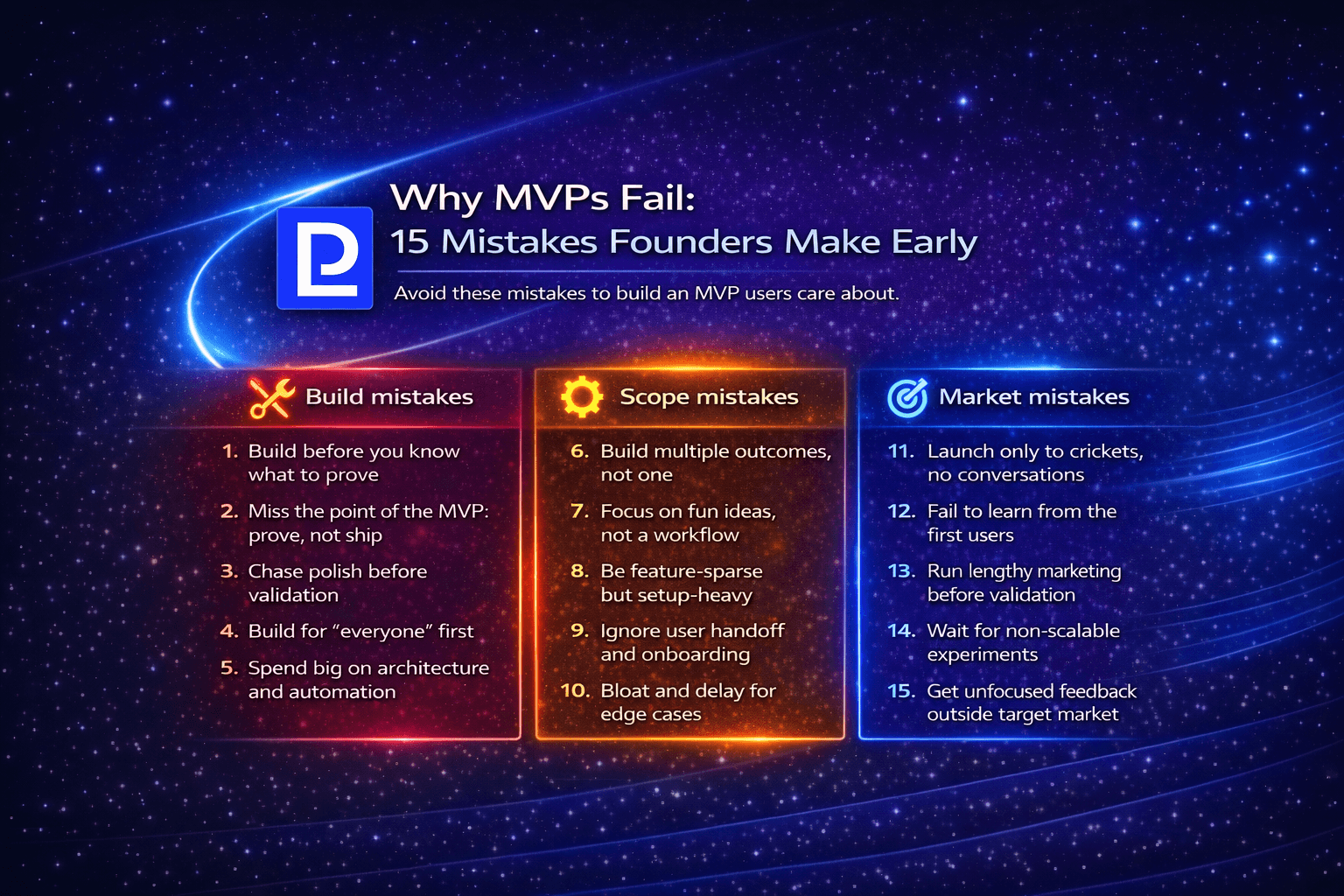
Technology • 3 min
Why MVPs Fail: 15 Mistakes Founders Make Early
A founder-focused guide to the 15 most common MVP mistakes: what causes failure, how to avoid them, and how to build MVPs that actually validate.
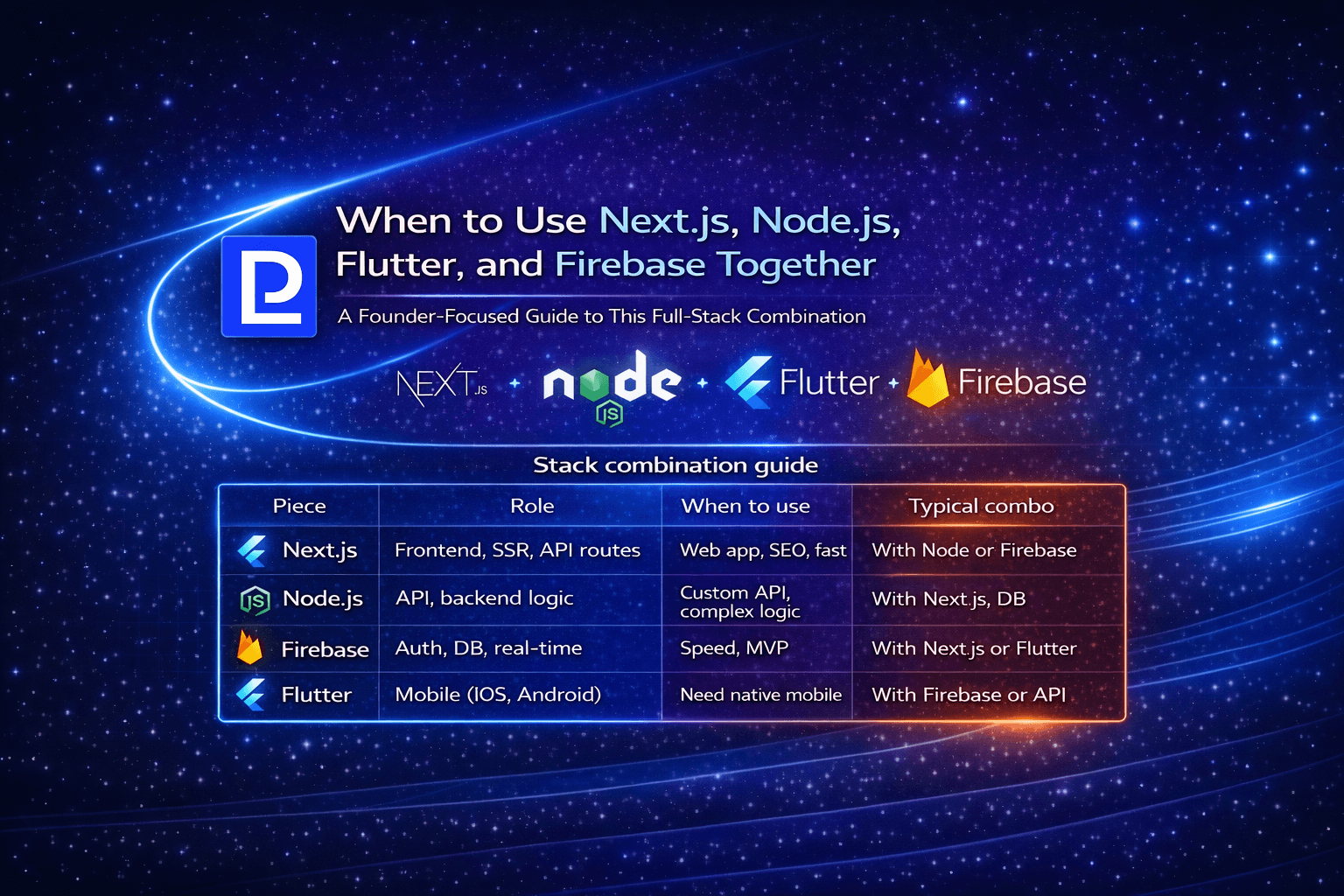
Technology • 3 min
When to Use Next.js, Node.js, Flutter, and Firebase Together
A founder-focused guide to combining Next.js, Node.js, Flutter, and Firebase: when the stack makes sense and how to use them together.
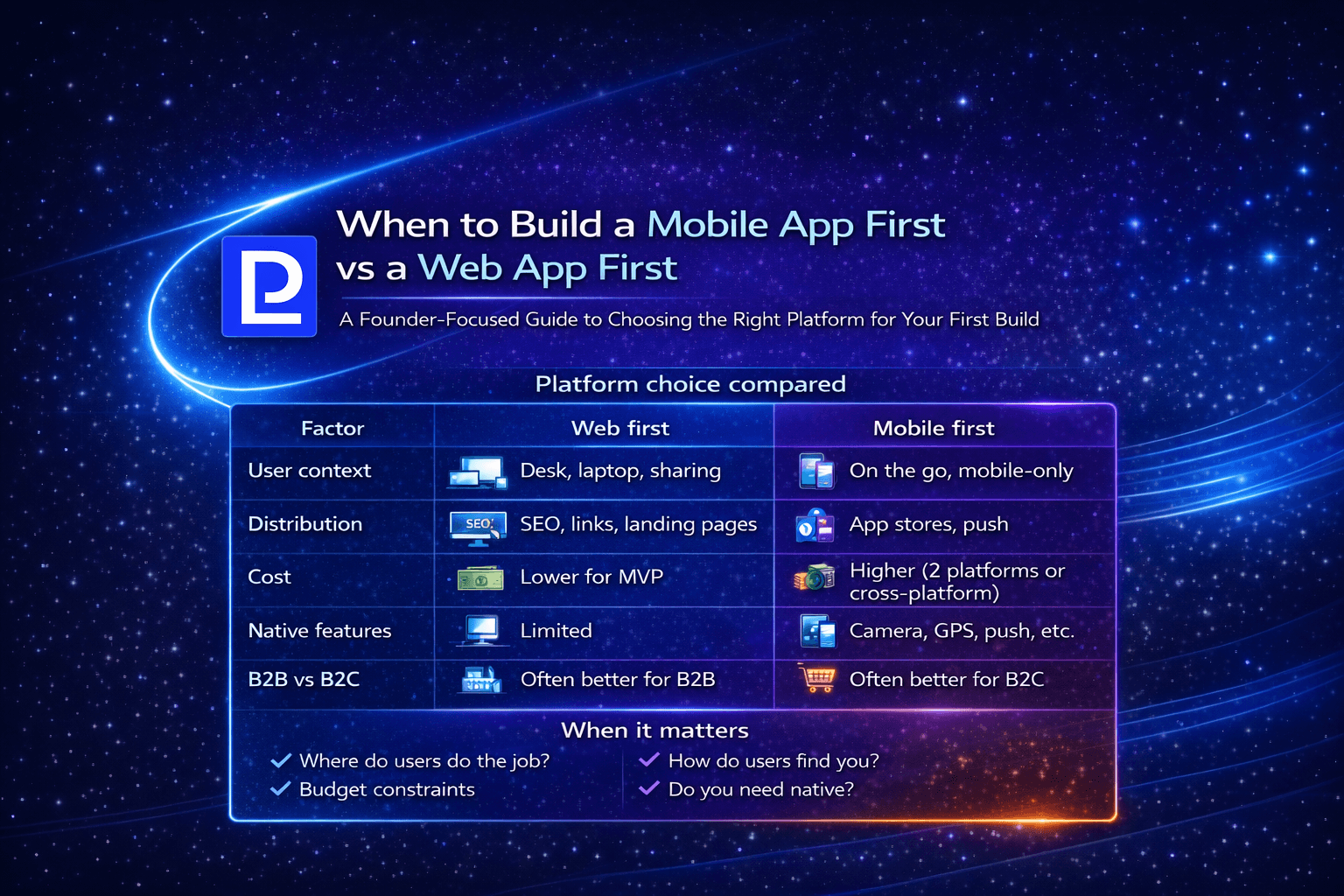
Technology • 3 min
When to Build a Mobile App First vs a Web App First
A founder-focused guide to choosing mobile-first vs web-first: when each makes sense, tradeoffs, and how to decide for your product.