SaaS Database Design Guide for Modern Products
A SaaS database design guide for modern products, with practical advice on schema choices, tradeoffs, and what founders should care about early.

Key Takeaways
- 01
SaaS database design guide works better when founders tie scope to a concrete business outcome instead of a broad wishlist.
- 02
Quick answer: Design the data model around entities, boundaries, and lifecycle events rather than around UI screens.
- 03
Strong data architecture decisions come from clear tradeoffs around budget, speed, reliability, and team capacity.
- 04
Shorter, clearer sections make the article easier to scan and easier for buyers to act on.
- 05
Common founder mistake: Optimizing only for the first screen instead of the future queries the business will inevitably need: reporting, permissions, audit trails, and billing.
- 06
The best next step is usually a narrower plan with a stronger first release, not a larger backlog around database design.
SaaS Database Design Guide for Modern Products matters because buyers do not reward software that is only technically correct. They reward software that solves a real workflow, looks credible, and is easy to evaluate. A SaaS database design guide for modern products, with practical advice on schema choices, tradeoffs, and what founders should care about early.
If you are researching saas database design guide, the useful questions are practical ones: what should be built first, what should be delayed, where does the budget really move, and which tradeoffs are worth making now. That is the frame this guide uses.
Quick answer
SaaS database design guide should favor clarity, observability, and sensible boundaries over premature complexity.
- Design around how the product actually works, not how a conference talk says it should work.
- Make the hard-to-reverse decisions explicit early.
- Keep operations understandable for the current team, not an imagined future team.
Who this guide is for
This article is for founders, product teams, and buyers reviewing architecture decisions with real business consequences.
It is especially useful when the system must stay simple enough to ship quickly but structured enough to survive growth.
- Useful when a partner is recommending architecture that sounds heavier than necessary.
- Useful when the team needs to know what must be right in version one.
- Useful when performance, permissions, or tenant boundaries will matter soon.
SaaS database design guide in plain English
The architecture should make the business easier to operate, easier to change, and easier to trust under real use.
| Architecture block | Why it matters | What goes wrong when ignored |
|---|---|---|
| Identity and access | Who is using the system and what they can do | Weak auth, role confusion, and support headaches |
| Core data model | How product entities relate and change over time | Reporting pain and hard-to-reverse schema debt |
| Application services | Where business rules, jobs, and integrations live | Fragile workflows and hidden failure modes |
| Operations and visibility | Deployments, logs, monitoring, and backups | Slow incident response and lower customer trust |
The layers founders should pressure-test first
| Architecture layer | What good looks like | Failure mode to avoid |
|---|---|---|
| Identity and permissions | Explicit account boundaries and role rules | Permission logic scattered across the app |
| Data model | Clear business entities and relationships | Tables or collections shaped around screens instead of workflows |
| Background work | Retries, queues, and failure handling | Silent job failures that only show up in support tickets |
| Observability | Logs, monitoring, and alerts that explain incidents | A system nobody can debug confidently under load |
Where simple usually wins
- When the team is still validating product shape.
- When a modular monolith can still support the whole release without pain.
- When the product needs better visibility before it needs more abstraction.
Where extra structure is worth paying for
- When multi-tenant boundaries, billing logic, or compliance concerns are central to the product.
- When integrations and background workflows create failure modes that need explicit ownership.
- When growth is already exposing query, caching, or isolation issues that are hurting customers.
Common architecture mistake
The most common mistake is buying complexity before the product has earned it. Architecture should remove likely business risk, not add prestige cost.
Founder note
A short architecture review through software consulting often saves far more money than it costs, because it exposes which decisions are expensive to reverse and which ones are still safe to postpone.
Architecture review checklist
- Ask what the system must support in the next 12 months, not in a perfect future state.
- Check how permissions, data, jobs, and monitoring are handled.
- Look for the most expensive-to-reverse decision and pressure-test that first.
- Prefer explicit boundaries over clever hidden ones.
- Choose the design the team can actually operate with confidence.
What to do next
This imported article will render best when the content keeps one clear table, one mistake box, and one checklist. That structure makes architecture content feel understandable instead of abstract, which is exactly what founders need.
Apply this in a real project
If you’re planning to build or improve software based on these ideas, our custom software development services can help you define scope, reduce delivery risk, and ship maintainable systems.
For founder-led execution, explore our product development services and software consulting services to turn requirements into a working release with clear ownership.
Expert Insights
Workflow clarity beats feature quantity
The strongest startup products feel focused because the team chose one painful workflow and made it easier, faster, or safer. Everything else can wait.
Good structure creates trust
When an article or a product is easier to scan, compare, and act on, buyers trust it more. Strong information design is a business lever, not decoration.
Execution quality is visible in the small details
Titles, tables, lists, and decision frameworks should make thinking easier. Common founder mistake: Optimizing only for the first screen instead of the future queries the business will inevitably need: reporting, permissions, audit trails, and billing. The same principle applies to product delivery.
Reader Rating
Based on 1 reviews
Frequently Asked Questions
How should founders evaluate saas database design guide?+
What usually causes projects to run longer or cost more?+
Should I optimize for speed or long-term flexibility first?+
When is an outside development partner a better choice than hiring in-house immediately?+
What should always be clarified before signing a project?+
Reader Questions
How do I know if I am underbuilding versus just being disciplined?
If the core user cannot complete the main job or the product cannot produce a meaningful business signal, you may be underbuilding. If secondary scenarios are simply deferred, that is usually healthy discipline.
What part of the project should I stay closest to as a founder?
Stay closest to workflow decisions, prioritization, and acceptance criteria. Founders create the most leverage when they reduce ambiguity quickly.
How much future-proofing should I pay for in the first release?
Pay for decisions that are expensive to reverse, such as the core data model, identity model, or tenant boundaries. Do not overpay for speculative complexity.
Related Articles
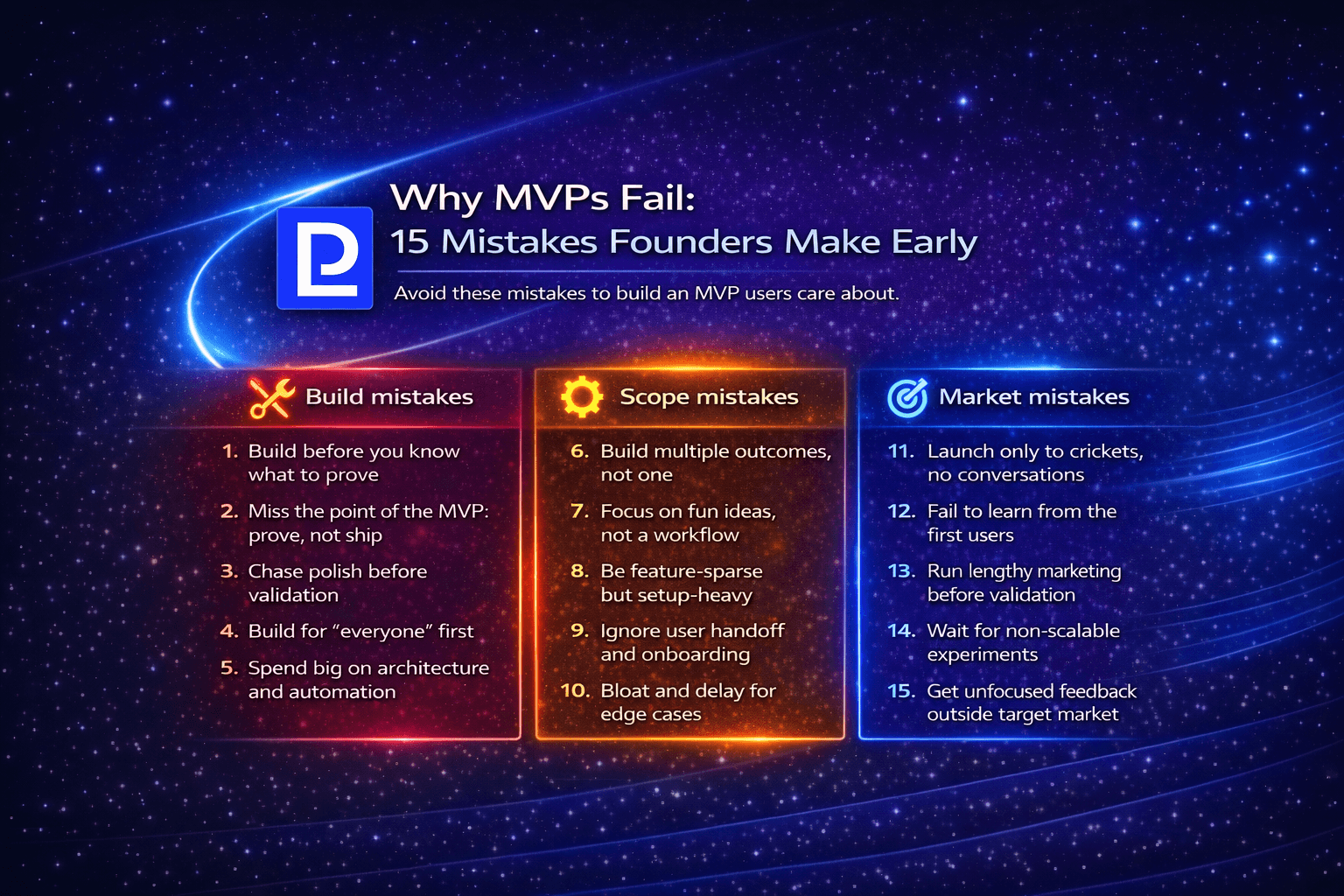
Technology • 3 min
Why MVPs Fail: 15 Mistakes Founders Make Early
A founder-focused guide to the 15 most common MVP mistakes: what causes failure, how to avoid them, and how to build MVPs that actually validate.
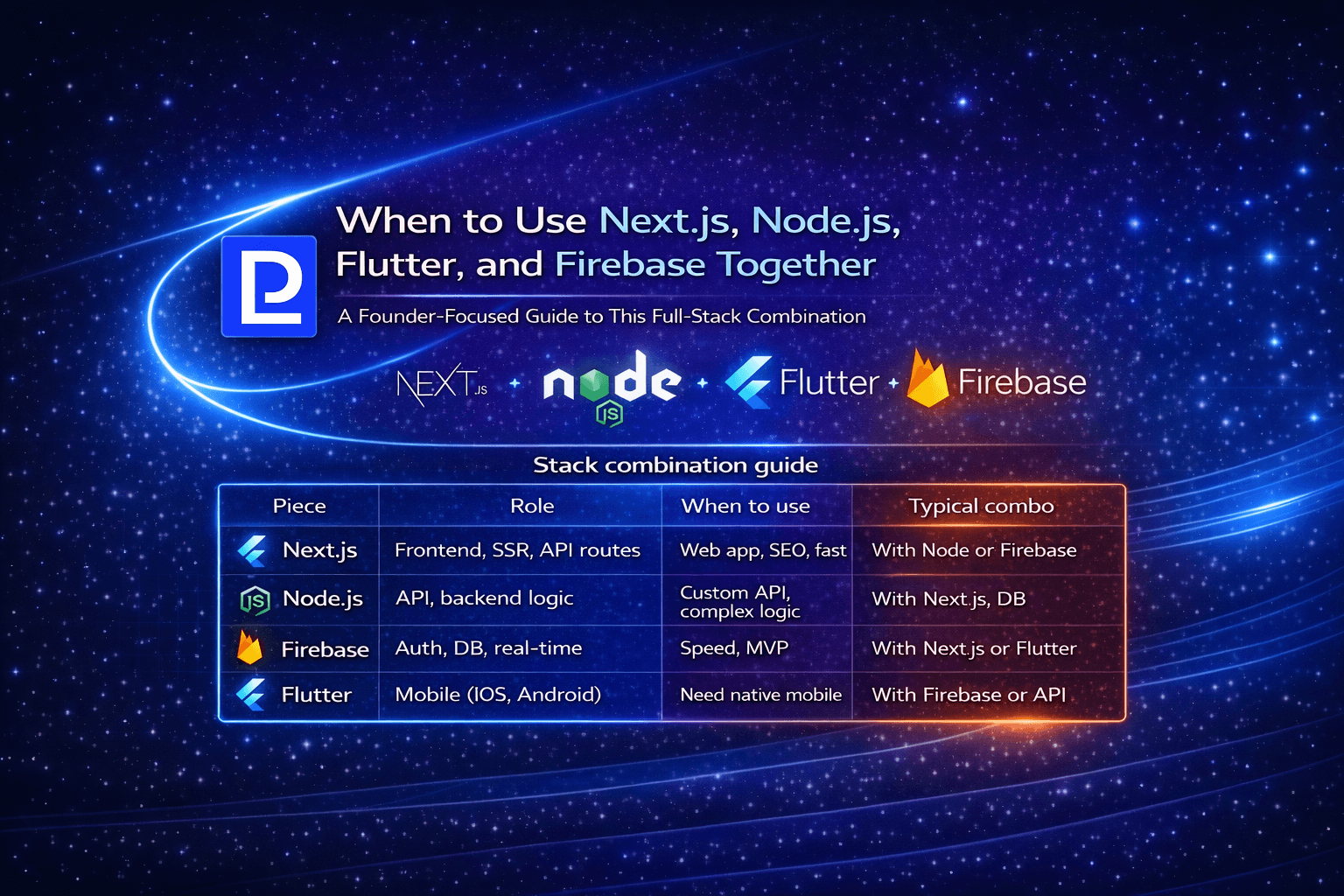
Technology • 3 min
When to Use Next.js, Node.js, Flutter, and Firebase Together
A founder-focused guide to combining Next.js, Node.js, Flutter, and Firebase: when the stack makes sense and how to use them together.
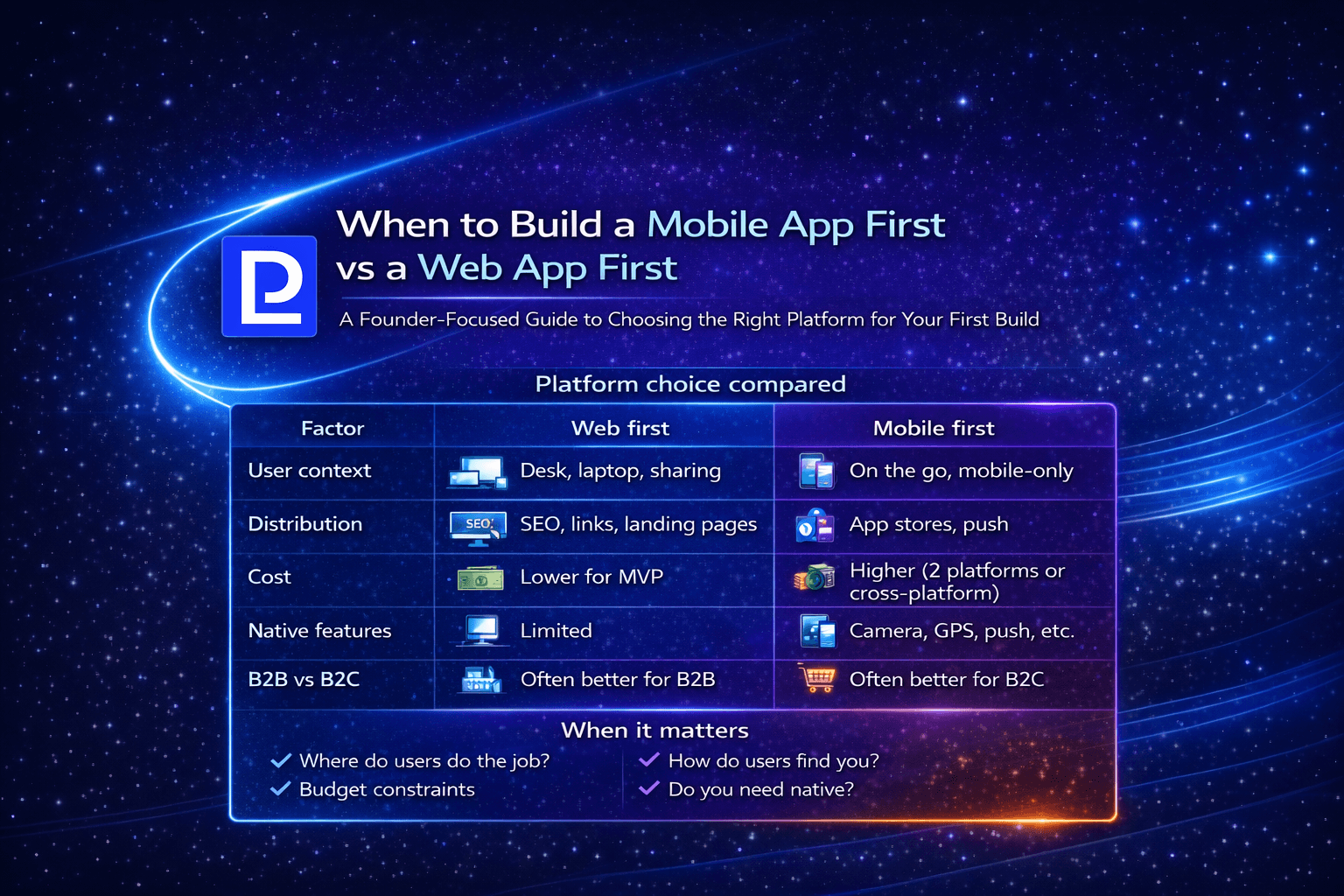
Technology • 3 min
When to Build a Mobile App First vs a Web App First
A founder-focused guide to choosing mobile-first vs web-first: when each makes sense, tradeoffs, and how to decide for your product.