How Much Does It Cost to Build a SaaS Product
A grounded SaaS product development cost guide for founders comparing MVP budgets, architecture tradeoffs, and the real scope behind quoted price ranges.
Key Takeaways
- 01
Saas product development cost is driven more by workflow complexity than by simple screen count.
- 02
Useful estimates separate included scope, excluded scope, support, and third-party costs.
- 03
Most founders should buy validation before they buy scale.
- 04
Integrations, permissions, reporting, and QA usually move budgets faster than visual polish alone.
- 05
A disciplined scope is often the cheapest path to a better launch.
How Much Does It Cost to Build a SaaS Product matters because buyers and founders need a clear answer, not a vague range or a stack of agency buzzwords. This guide explains saas product development cost in a commercially realistic way so you can make better product, budget, and delivery decisions.
The short version: most quotes move up or down based on workflow count, integrations, user roles, reporting needs, and how much operational polish is required in version one. Founders usually overspend when they try to buy scale before they have proof that customers care.
Quick answer
saas product development cost should be evaluated through scope, delivery risk, and business usefulness, not just a headline number or trend-driven opinion.
- Budget is mostly a function of workflow complexity, not just screen count.
- Version one should prove value before you pay for broad automation or edge-case polish.
- Good estimates separate included scope, excluded scope, and post-launch support.
Who this guide is for
This guide is for founders, SaaS buyers, and business owners trying to match budget to product stage. It is especially useful if you are comparing quotes and need to understand what is actually included, what is usually excluded, and where hidden costs appear.
What actually changes software budgets
Budgets move fastest when the product adds more states, more user roles, more integrations, or more operational reliability requirements. A simple CRUD app and a real SaaS workflow can look similar in a mockup while being dramatically different in engineering effort.
That is why useful estimates describe assumptions. If an estimate does not clearly separate included features, excluded work, third-party fees, launch support, and change requests, the number is not giving you much safety.
| SaaS stage | Typical spend | Focus | Main risk |
|---|---|---|---|
| Pre-PMF MVP | $20K-$60K | Validate one painful workflow | Overbuilding before signal |
| Early traction build | $60K-$120K | Improve reliability, billing, reporting | Weak data model or tenant design |
| Scale-ready SaaS | $120K+ | Security, automation, performance, integrations | Complexity outpacing revenue |
Software as a Service (SaaS) has become one of the most successful business models in the technology industry. From startups to enterprise companies, many organizations build SaaS products to deliver scalable digital products.
However, one of the most common questions founders ask is: how much does it cost to build a SaaS product?
The answer depends on multiple factors such as product complexity, features, infrastructure, integrations, and development resources. Understanding these factors helps businesses plan realistic budgets and development timelines.
What Is a SaaS Product?
A SaaS product is a cloud-based software application that users access through the internet rather than installing it on their local devices. SaaS products typically operate on subscription models where users pay monthly or yearly fees to access the service.
Popular examples of SaaS products include project management tools, CRM systems, collaboration platforms, and analytics dashboards.
Average Cost to Build a SaaS Product
The cost of SaaS product development varies depending on complexity and functionality.
- Basic SaaS MVP: $25,000 – $60,000
- Mid-level SaaS product: $60,000 – $150,000
- Advanced SaaS product: $150,000 – $400,000+
These estimates include design, development, infrastructure setup, testing, and deployment.
Key Factors That Influence SaaS Development Cost
Product Complexity
The complexity of the product significantly impacts development cost. A simple dashboard application costs far less than a platform with real-time analytics, automation workflows, or AI features.
Number of Features
The more features a SaaS product includes, the more development time and resources are required. Founders often begin with an MVP to reduce cost and validate the product idea.
Technology Stack
The technologies used to build the platform influence development cost. Modern SaaS applications typically use frameworks such as React or Next.js for frontend development and scalable backend environments such as Node.js or cloud infrastructure.
UI and User Experience
SaaS products rely heavily on user experience. A well-designed interface improves user engagement and retention but requires additional design effort.
Infrastructure and Cloud Services
Cloud infrastructure plays a major role in SaaS products. Costs include servers, databases, content delivery networks, and monitoring systems.
Security and Compliance
Security is critical for SaaS products that handle user data. Implementing authentication, encryption, and compliance features increases development effort.
SaaS MVP Development Strategy
Many startups begin by building a Minimum Viable Product (MVP). An MVP contains only the core features required to validate the product idea.
This approach allows startups to launch quickly, collect user feedback, and improve the platform before investing in full-scale development.
MVP development usually costs significantly less than building the complete product.
Development Team Structure
The cost of building a SaaS product also depends on the size and expertise of the development team.
A typical SaaS development team may include:
- Product manager
- UI/UX designer
- Frontend developer
- Backend developer
- QA engineer
- DevOps engineer
Some companies outsource development to specialized software development firms to reduce hiring complexity.
Hidden Costs of SaaS Products
Beyond development, SaaS products require ongoing operational costs. These may include:
- Cloud hosting
- Maintenance and updates
- Customer support
- Security monitoring
- Marketing and user acquisition
Businesses should plan for these long-term expenses when budgeting for SaaS products.
How to Reduce SaaS Development Cost
Startups can reduce development costs by focusing on essential features and launching an MVP first. Prioritizing the core value proposition helps avoid unnecessary development work.
Working with an experienced SaaS development company also helps optimize architecture and development efficiency.
Conclusion
Building a SaaS product requires careful planning, strong technical architecture, and a clear understanding of user needs. Development costs vary widely depending on product complexity, features, and infrastructure requirements.
Many successful SaaS companies start with an MVP to validate their idea before scaling the platform.
Businesses that plan development strategically and choose the right development partner can build scalable SaaS products while controlling costs.
Cost breakdown by components
- Auth + roles: role/permission design + auditability
- Billing: subscriptions, invoices, retries, tax handling
- Admin tooling: internal ops panels, support workflows
- Integrations: payments, email, analytics, CRM, data imports
- Security: access controls, logging, vulnerability review
If you want a scoped build with clear milestones, see our product development services and custom software development services.
How to decide if the budget is enough
Choose the lower end of the range only if the product has one narrow workflow, limited integrations, and a founder willing to simplify aggressively. Move up the range when the product has team features, permissions, billing logic, reporting, or compliance pressure.
Common budgeting mistake
Founders often compare proposals as if they represent the same scope. They rarely do. A low quote that skips QA, release planning, support, or edge cases is not cheaper if it forces rework a month later.
Budget checklist
- Define the one workflow the first release must prove.
- List included scope and excluded scope separately.
- Clarify third-party fees, support, and change-request handling.
- Check whether the estimate assumes founder-ready content, copy, and decisions.
- Match the budget to the validation stage, not the final product vision.
Related reading: MVP cost breakdown, what different budgets usually buy, and our pricing page.
What to do next
Turn the budget conversation into a scope conversation. Write down the first workflow, the required roles, the integrations, and the launch goal, then compare proposals against that reality. If you want a grounded estimate, start with our pricing page or contact our team.
Apply this in a real project
If you’re planning to build or improve software based on these ideas, our custom software development services can help you define scope, reduce delivery risk, and ship maintainable systems.
For founder-led execution, explore our product development services and web development services to turn requirements into a working release with clear ownership.
Expert Insights
Most cost mistakes are scope mistakes
Teams rarely blow budgets because code is inherently expensive. They blow budgets because important assumptions about workflow, integration, or operational complexity were never made explicit.
Founders should price learning separately from scale
The cheapest smart decision is often to validate with a narrower product before investing in architecture and automation that only matter after traction.
Frequently Asked Questions
What usually increases software cost the fastest?+
What is usually not included in a basic quote?+
Should founders optimize for the cheapest possible MVP?+
How long do these projects usually take?+
How do I compare two estimates fairly?+
Reader Questions
How much budget should I hold back for after launch?
Most teams should keep some budget for fixes, onboarding improvements, and the first round of changes that only become obvious with real usage.
Is it smarter to cut scope or extend timeline?
Cutting non-essential scope is usually better than stretching a weak plan across more weeks, especially in an early-stage product.
How do I know whether I am paying for necessary complexity or fluff?
Ask which product requirement each expensive area supports. If it does not clearly change adoption, revenue, or reliability, challenge it.
Related Articles
Technology • 3 min
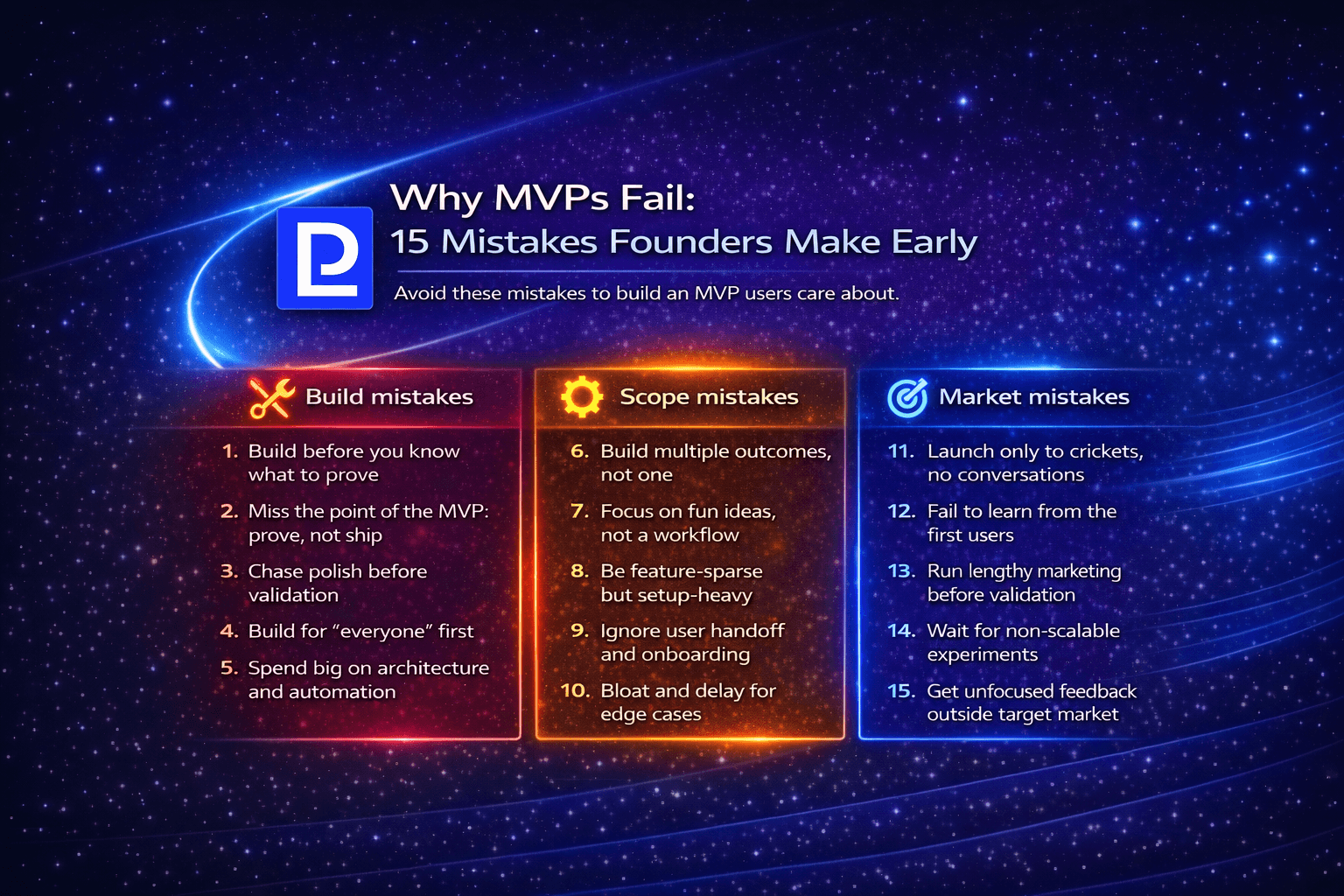
Why MVPs Fail: 15 Mistakes Founders Make Early
A founder-focused guide to the 15 most common MVP mistakes: what causes failure, how to avoid them, and how to build MVPs that actually validate.
Technology • 3 min
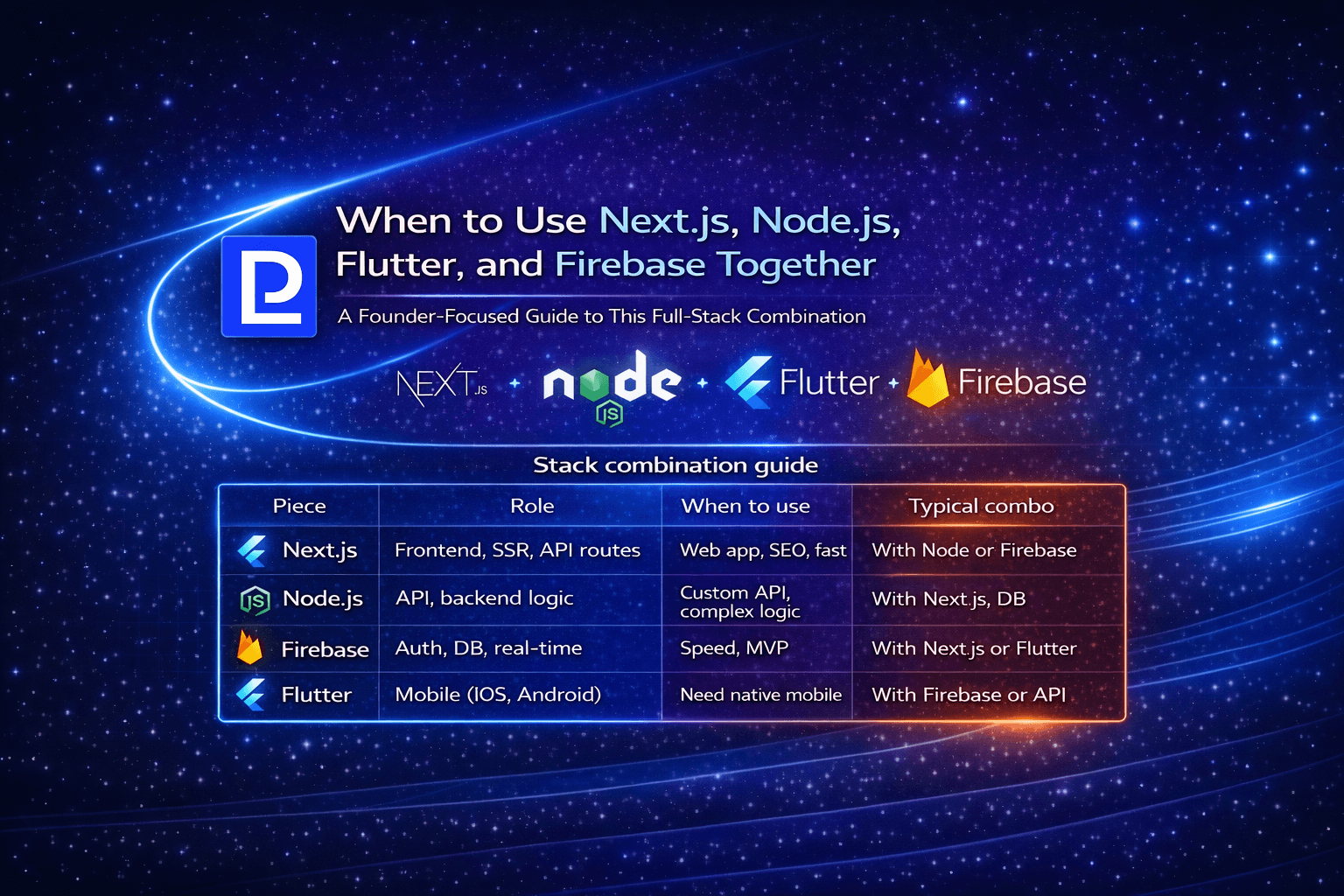
When to Use Next.js, Node.js, Flutter, and Firebase Together
A founder-focused guide to combining Next.js, Node.js, Flutter, and Firebase: when the stack makes sense and how to use them together.
Technology • 3 min
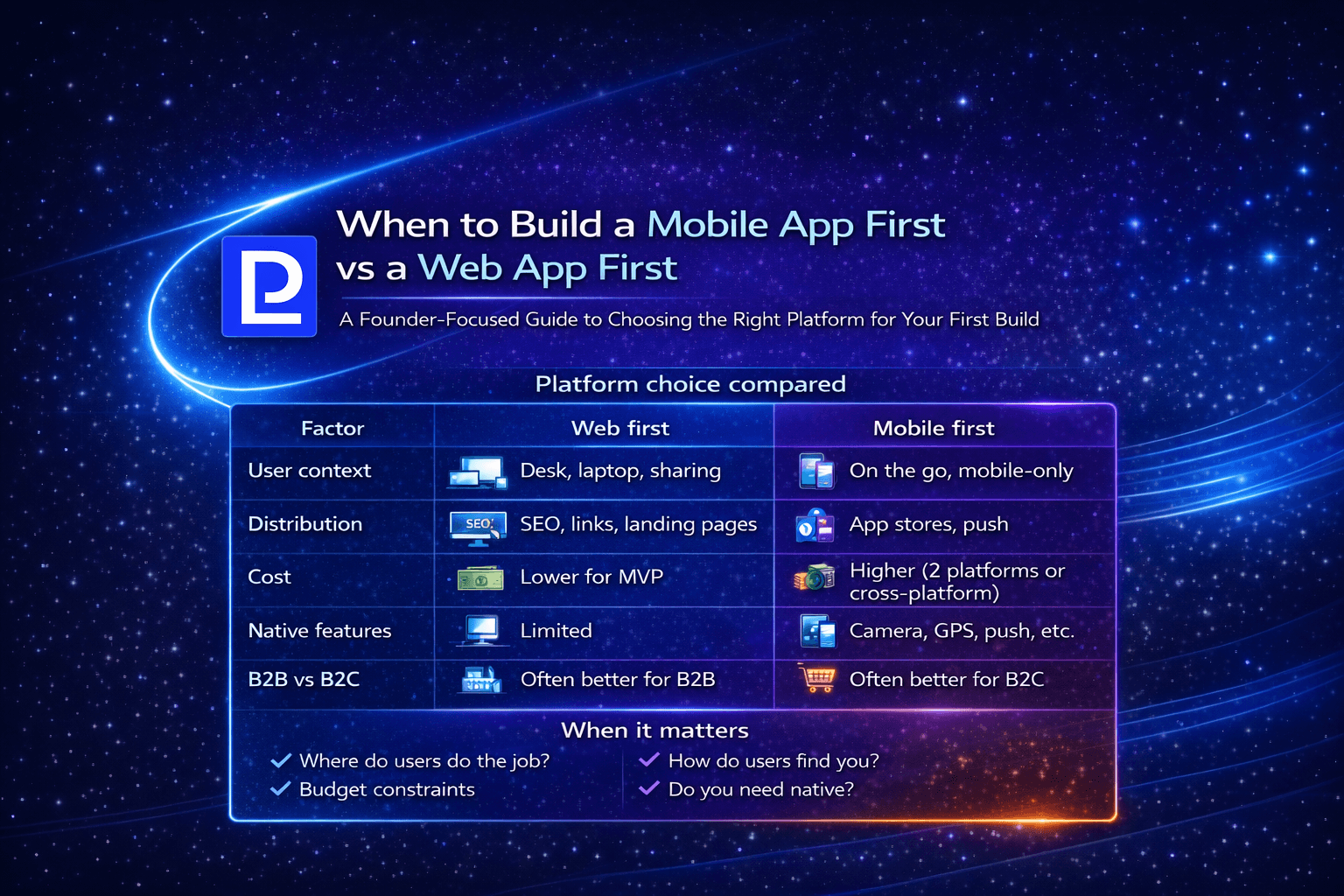
When to Build a Mobile App First vs a Web App First
A founder-focused guide to choosing mobile-first vs web-first: when each makes sense, tradeoffs, and how to decide for your product.