MVP Development for Startups: Cost, Timeline, and Strategy
A founder guide to MVP development for startups covering scope, budget, delivery timing, tradeoffs, and what to build first versus later.
Key Takeaways
- 01
An MVP should answer one business question clearly.
- 02
The first release is stronger when it centers on one value loop and cuts secondary workflows.
- 03
Manual operations are often acceptable if they reduce early engineering waste.
- 04
Launch planning should include feedback and measurement, not just shipping.
- 05
Founders create leverage by making scope decisions quickly and explicitly.
MVP Development for Startups: Cost, Timeline, and Strategy matters because buyers and founders need a clear answer, not a vague range or a stack of agency buzzwords. This guide explains mvp development for startups in a commercially realistic way so you can make better product, budget, and delivery decisions.
The short version: a strong MVP is not a smaller full product. It is a deliberately narrow release built to answer one commercial question with as little wasted engineering as possible.
Quick answer
mvp development for startups should be evaluated through scope, delivery risk, and business usefulness, not just a headline number or trend-driven opinion.
- Build the smallest workflow that can prove a business decision.
- Defer complexity that does not change learning or revenue.
- Launch plans should include feedback loops, not just build tasks.
Who this guide is for
This guide is for startup founders, product teams, and service businesses turning an idea into a first release that can test demand or operational value.
What to build first and what to delay
Good MVP planning starts with the main user journey and the smallest version of it that still creates a meaningful result. That often means one persona, one clear workflow, and basic operations hidden behind simple admin tooling rather than expensive automation.
What should wait? Multi-role complexity, advanced reporting, broad permissions, and workflows that only matter after adoption. Early-stage teams save money when they postpone complexity that has not earned its place yet.
| MVP phase | What matters most | Common trap |
|---|---|---|
| Discovery | User workflow and success metric | Jumping into screens too early |
| Build | One narrow value loop | Trying to please every stakeholder |
| Launch | Feedback and usage instrumentation | Treating launch as the finish line |
Launching a startup product without validating the idea can be risky and expensive. Many successful startups begin with an MVP — a Minimum Viable Product — to test their concept with real users before building a full-scale platform.
MVP development allows founders to build a simplified version of their product that focuses only on the most important features. This approach reduces development costs, speeds up product launch, and provides valuable feedback from early users.
Working with an experienced MVP development company helps startups move from idea to product efficiently while avoiding common development mistakes.
What Is MVP Development?
MVP development is the process of building the simplest version of a product that still solves a core user problem. Instead of building a fully featured platform, startups launch a smaller product that focuses only on essential functionality.
The goal of an MVP is not perfection. The goal is validation. By launching early, startups can understand how real users interact with their product and identify improvements before scaling development.
Why Startups Choose MVP Development
Many startups fail because they invest too much time and money building products before validating market demand. MVP development reduces this risk by allowing startups to launch faster and test their ideas with real users.
Key benefits of MVP development include:
- Faster product launch
- Lower development costs
- Real user feedback
- Early market validation
- Ability to pivot quickly
- Better investor confidence
Instead of guessing what users want, startups can learn directly from real usage.
What Does an MVP Development Company Do?
An MVP development company helps startups turn product ideas into working applications. Their role usually includes product planning, UI/UX design, development, testing, and deployment.
Professional MVP development teams focus on building only the essential features required to validate the product idea.
Typical services include:
- Product discovery and feature planning
- Market validation support
- UI/UX design and wireframes
- Frontend and backend development
- API integrations
- Testing and quality assurance
- Cloud deployment
The goal is to launch quickly while keeping the system scalable for future growth.
MVP Development Timeline
The timeline for MVP development depends on the complexity of the product and the number of features included. However, most startup MVPs follow a similar development structure.
Product Discovery (1–2 Weeks)
This phase focuses on defining the core problem, identifying target users, and selecting the most important features for the MVP.
Design and Prototyping (2–3 Weeks)
UI/UX designers create wireframes and prototypes that define the product experience. This step helps validate the product concept before development begins.
Development (6–10 Weeks)
Engineers build the frontend interface, backend systems, and database architecture needed to run the application.
Testing and Launch (1–2 Weeks)
Before launching the MVP, teams test the product to ensure it performs reliably and fixes critical bugs.
Most startup MVPs can be launched within 2 to 4 months depending on complexity.
MVP Development Cost
The cost of MVP development depends on product complexity, design requirements, integrations, and technology stack.
Typical MVP development costs include:
- Basic MVP: $15,000 – $30,000
- Moderate complexity MVP: $30,000 – $80,000
- Advanced startup platform: $80,000 – $150,000
These estimates vary depending on the development partner and project scope.
Key Features an MVP Should Include
Startups often make the mistake of adding too many features to their MVP. A successful MVP focuses only on solving the primary user problem.
Essential MVP components include:
- User authentication
- Core product functionality
- Basic dashboard or interface
- Data storage and backend system
- Analytics or usage tracking
Additional features can be added later once the product idea is validated.
Common MVP Development Mistakes
Many startups struggle during MVP development because they misunderstand the purpose of the product.
Common mistakes include:
- Trying to build too many features
- Skipping user research
- Ignoring scalability
- Choosing technology based only on trends
- Not collecting user feedback
A strong MVP development strategy focuses on learning and iteration rather than perfection.
How to Choose the Right MVP Development Company
Choosing the right development partner can significantly impact the success of your startup product.
Look for a company that offers:
- Startup product experience
- Strong UI/UX design capability
- Scalable architecture planning
- Transparent development process
- Post-launch support
A reliable MVP development company should act as a product partner rather than just a development vendor.
Conclusion
MVP development is one of the most effective strategies for startups building new digital products. By launching a simplified version of the product, founders can validate their ideas, gather real user feedback, and improve the product before investing in full-scale development.
Working with an experienced MVP development company helps startups build faster, reduce risk, and create scalable products designed for long-term growth.
MVP scope examples (so you don’t overbuild)
B2B SaaS MVP: authentication + roles, one core workflow, basic billing later, admin panel essentials, analytics.
Marketplace MVP: listings, search, messaging, basic payments, simple trust/safety rules, manual ops tools first.
What to remove from MVP scope
- Complex role systems until the workflow is validated
- Advanced automation and integrations until usage is proven
- Perfect UI polish before core retention is clear
If you want founder-led delivery with clear milestones, see our product development services and web development services.
Choose a narrower MVP when...
If the team is still learning who the main user is, how adoption will happen, or which part of the workflow creates value, choose a narrower MVP. Only widen scope when the business signal demands it.
Common founder mistake
Many teams treat the MVP as a small version of the final roadmap and end up shipping a product that is too wide to build efficiently and too unfocused to teach anything clearly.
MVP checklist
- Name the one metric or business question the release must answer.
- Identify the minimum user journey needed to answer it.
- Cut every feature that does not materially support that journey.
- Plan feedback capture and analytics before launch.
- Keep room in the budget for post-launch iteration.
Useful companion reads: MVP development for startups, MVP cost breakdown, and our product development process.
What to do next
Write the single question your MVP must answer, cut the roadmap until it serves that question, and review real product slices early. That is how founders protect both budget and momentum. If you need help shaping the first release, see our product development process and contact our team.
Apply this in a real project
If you’re planning to build or improve software based on these ideas, our custom software development services can help you define scope, reduce delivery risk, and ship maintainable systems.
For founder-led execution, explore our product development services and web development services to turn requirements into a working release with clear ownership.
Expert Insights
Version one should prove something important
An MVP is worth shipping only when it answers a real question about adoption, willingness to pay, or workflow value.
Manual operations are underrated
Founders often automate too soon. Manual handling in the first version can be a smart way to learn before engineering a brittle process.
Frequently Asked Questions
What should an MVP include?+
What should not be built first?+
How long should MVP development take?+
How do founders know the MVP is too small?+
What happens after the MVP launches?+
Reader Questions
How do I avoid underbuilding the MVP?
Make sure the core user can complete the core job. Underbuilding is a problem only when the product cannot create a meaningful signal.
Should I include payments in the first release?
Include them if willingness to pay is part of the question you need answered. Otherwise, you may be able to defer billing briefly.
What is the founder role during MVP delivery?
Founders are most valuable when they clarify priorities quickly, review live product slices, and keep the build tied to the real business goal.
Related Articles
Technology • 3 min
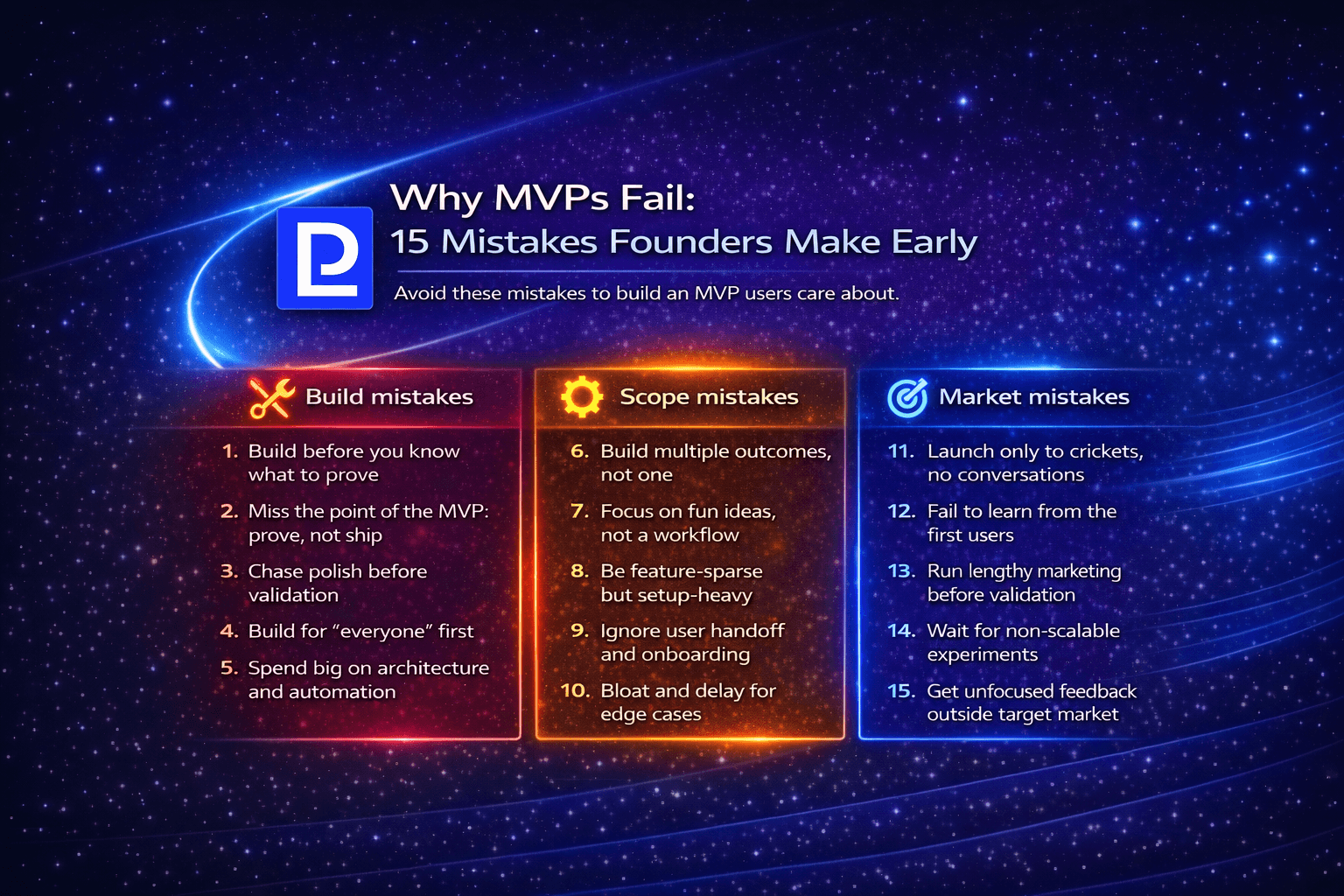
Why MVPs Fail: 15 Mistakes Founders Make Early
A founder-focused guide to the 15 most common MVP mistakes: what causes failure, how to avoid them, and how to build MVPs that actually validate.
Technology • 3 min
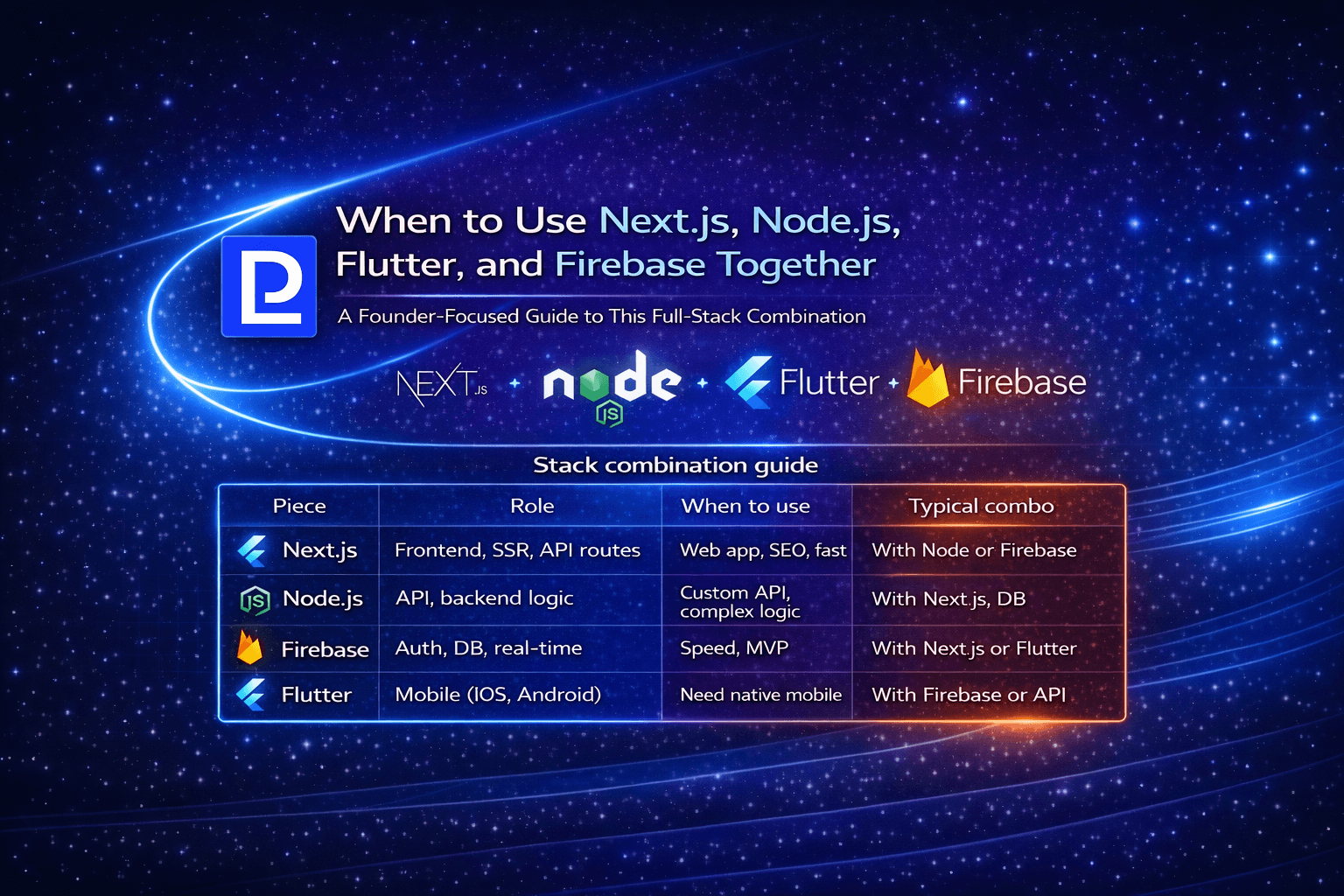
When to Use Next.js, Node.js, Flutter, and Firebase Together
A founder-focused guide to combining Next.js, Node.js, Flutter, and Firebase: when the stack makes sense and how to use them together.
Technology • 3 min
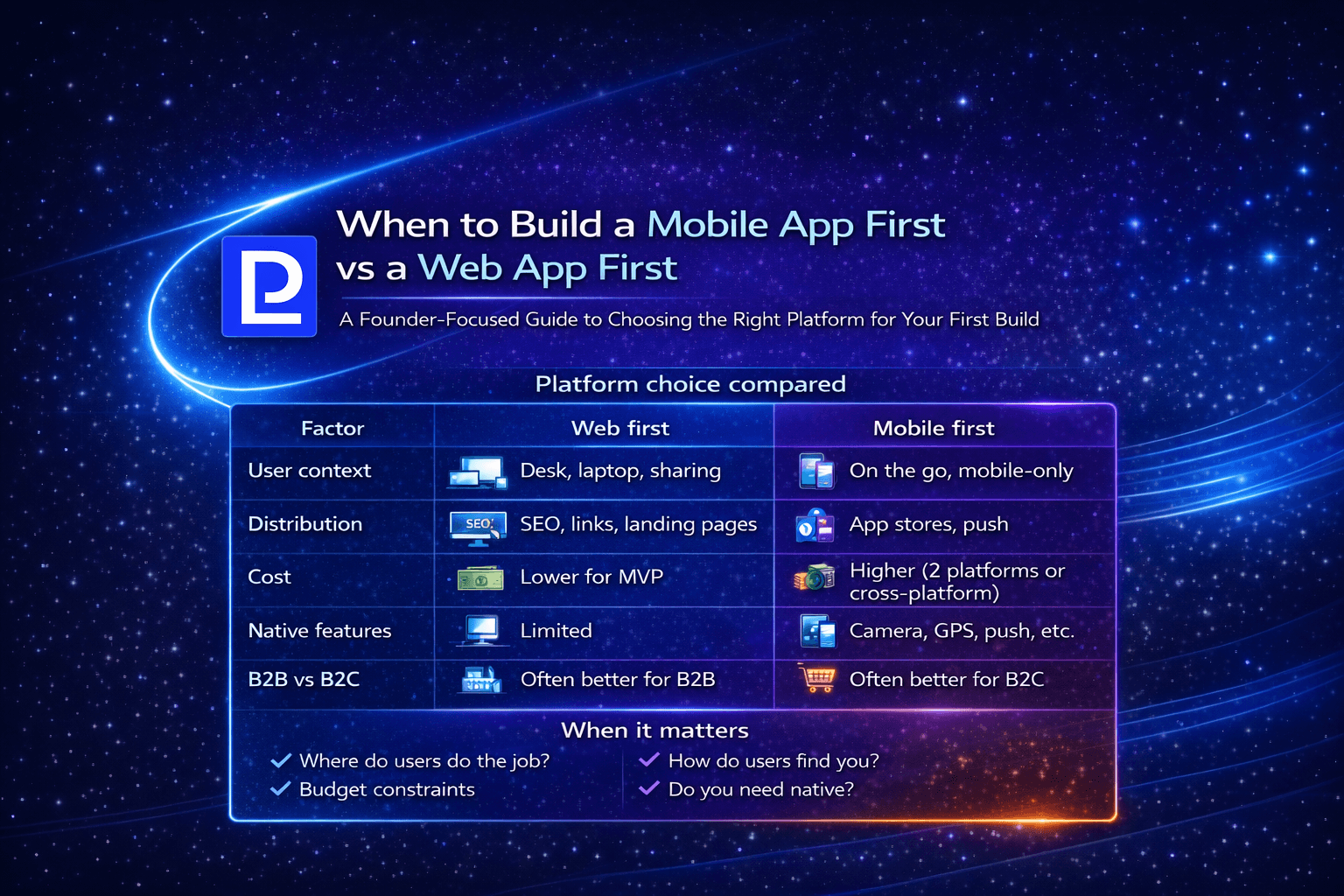
When to Build a Mobile App First vs a Web App First
A founder-focused guide to choosing mobile-first vs web-first: when each makes sense, tradeoffs, and how to decide for your product.