5 Lessons Learned From Launching 5 MVPs
Five practical lessons from MVP launches, focused on the mistakes that actually cost founders time, money, and momentum after release.
Key Takeaways
- 01
An MVP should answer one business question clearly.
- 02
The first release is stronger when it centers on one value loop and cuts secondary workflows.
- 03
Manual operations are often acceptable if they reduce early engineering waste.
- 04
Launch planning should include feedback and measurement, not just shipping.
- 05
Founders create leverage by making scope decisions quickly and explicitly.
5 Lessons Learned From Launching 5 MVPs matters because buyers and founders need a clear answer, not a vague range or a stack of agency buzzwords. This guide explains mvp launch lessons in a commercially realistic way so you can make better product, budget, and delivery decisions.
The short version: a strong MVP is not a smaller full product. It is a deliberately narrow release built to answer one commercial question with as little wasted engineering as possible.
Quick answer
mvp launch lessons should be evaluated through scope, delivery risk, and business usefulness, not just a headline number or trend-driven opinion.
- Build the smallest workflow that can prove a business decision.
- Defer complexity that does not change learning or revenue.
- Launch plans should include feedback loops, not just build tasks.
Who this guide is for
This guide is for startup founders, product teams, and service businesses turning an idea into a first release that can test demand or operational value.
What to build first and what to delay
Good MVP planning starts with the main user journey and the smallest version of it that still creates a meaningful result. That often means one persona, one clear workflow, and basic operations hidden behind simple admin tooling rather than expensive automation.
What should wait? Multi-role complexity, advanced reporting, broad permissions, and workflows that only matter after adoption. Early-stage teams save money when they postpone complexity that has not earned its place yet.
| Lesson | What it means in practice |
|---|---|
| Scope discipline matters more than enthusiasm | Cut anything that does not support the first value loop |
| Manual steps are fine early | Do not automate weak workflows too soon |
| Launch creates questions, not certainty | Prepare for iteration immediately after release |
We've shipped MVPs across B2B SaaS, marketplaces, and internal tools. Here are the lessons that stick—and what we'd do differently.
Lesson 1: Cut Scope Before You Start
Every MVP we've built had a feature list that was too long. The ones that shipped on time had one thing in common: we cut 30–40% of the initial scope in discovery.
What works: Prioritize by "what do we need to validate?" not "what would be nice?" If a feature doesn't answer a core hypothesis, defer it.
Lesson 2: Weekly Demos Beat Big-Bang Launches
Founders who saw working software every week stayed aligned. Those who waited for "launch day" got surprises—and rework.
What works: Ship something every 1–2 weeks. Even if it's incomplete, it creates feedback loops and prevents drift.
Lesson 3: Tech Stack Matters Less Than You Think
We've used Next.js, React + Node, and even Laravel. The stack didn't determine success. Process did.
What works: Pick something the team knows. Optimize for speed and maintainability, not trendiness.
Lesson 4: Documentation Pays Off Later
Two projects had clean handovers with docs. Three had minimal docs. The two with docs scaled smoothly. The others had "tribal knowledge" problems when we added developers.
What works: Document architecture, deployment, and key decisions as you build. Don't defer to "we'll document at the end."
Lesson 5: Founder Availability Is a Constraint
Projects where the founder was responsive (feedback within 24–48 hours) moved faster. Projects where decisions took a week stalled.
What works: Block 2–3 hours per week for the MVP. Treat it like a critical priority. Async is fine, but latency kills momentum.
What We'd Do Differently
- More customer interviews pre-build: We'd add 2–3 more before writing code.
- Earlier beta users: Get 3–5 users in by week 6, not week 12.
- Explicit "out of scope" list: Write down what we're NOT building. Reduces scope creep.
Conclusion
Scope control, weekly demos, pragmatic tech choices, documentation, and founder availability—these five factors mattered more than budget or team size. Apply them to your next MVP.
Choose a narrower MVP when...
If the team is still learning who the main user is, how adoption will happen, or which part of the workflow creates value, choose a narrower MVP. Only widen scope when the business signal demands it.
Common founder mistake
Many teams treat the MVP as a small version of the final roadmap and end up shipping a product that is too wide to build efficiently and too unfocused to teach anything clearly.
MVP checklist
- Name the one metric or business question the release must answer.
- Identify the minimum user journey needed to answer it.
- Cut every feature that does not materially support that journey.
- Plan feedback capture and analytics before launch.
- Keep room in the budget for post-launch iteration.
Useful companion reads: MVP development for startups, MVP cost breakdown, and our product development process.
What to do next
Write the single question your MVP must answer, cut the roadmap until it serves that question, and review real product slices early. That is how founders protect both budget and momentum. If you need help shaping the first release, see our product development process and contact our team.
Apply this in a real project
If you’re planning to build or improve software based on these ideas, our custom software development services can help you define scope, reduce delivery risk, and ship maintainable systems.
For founder-led execution, explore our product development services and web development services to turn requirements into a working release with clear ownership.
Expert Insights
Version one should prove something important
An MVP is worth shipping only when it answers a real question about adoption, willingness to pay, or workflow value.
Manual operations are underrated
Founders often automate too soon. Manual handling in the first version can be a smart way to learn before engineering a brittle process.
Reader Rating
Based on 1 reviews
Frequently Asked Questions
What should an MVP include?+
What should not be built first?+
How long should MVP development take?+
How do founders know the MVP is too small?+
What happens after the MVP launches?+
Reader Questions
How do I avoid underbuilding the MVP?
Make sure the core user can complete the core job. Underbuilding is a problem only when the product cannot create a meaningful signal.
Should I include payments in the first release?
Include them if willingness to pay is part of the question you need answered. Otherwise, you may be able to defer billing briefly.
What is the founder role during MVP delivery?
Founders are most valuable when they clarify priorities quickly, review live product slices, and keep the build tied to the real business goal.
Related Articles
Technology • 3 min
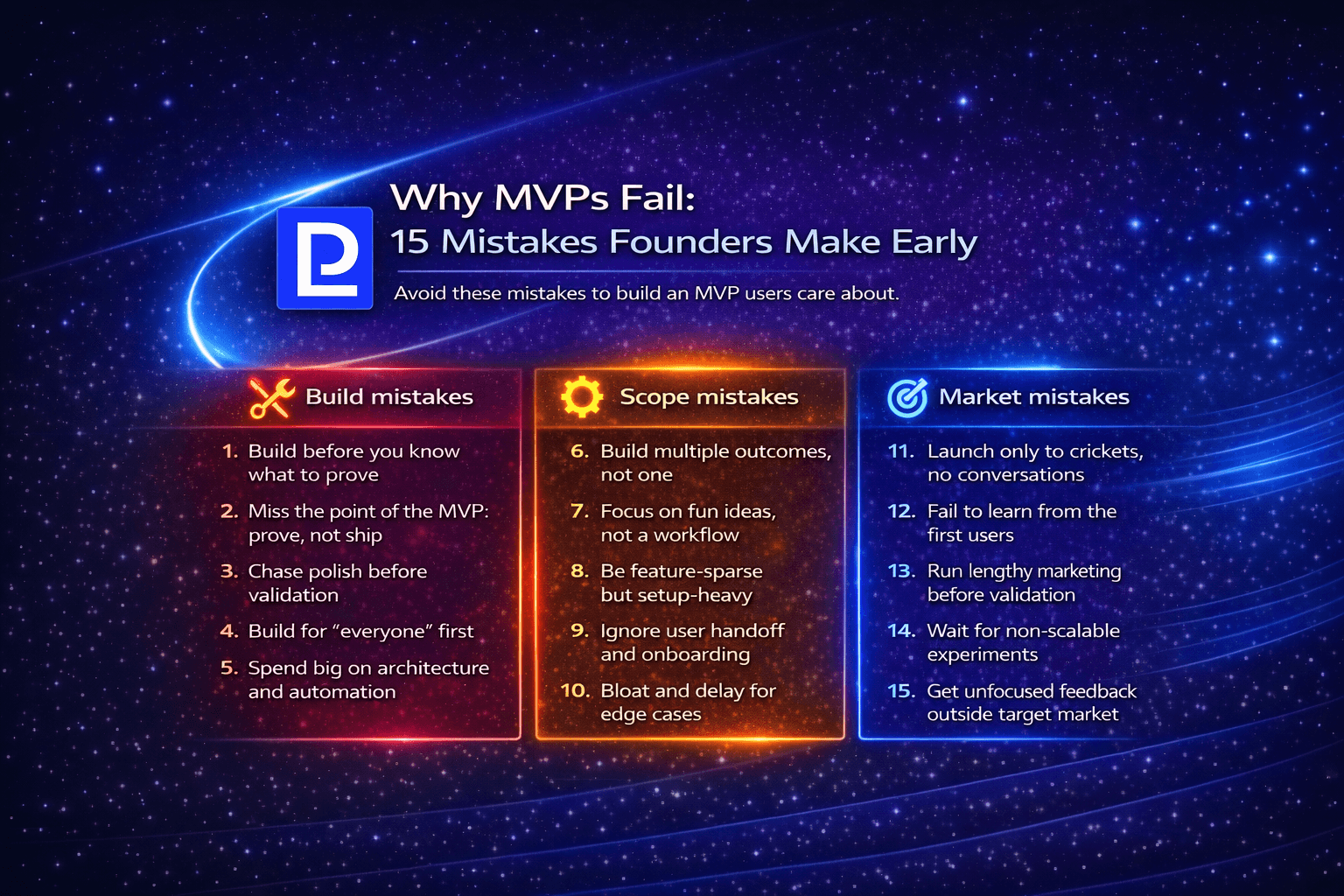
Why MVPs Fail: 15 Mistakes Founders Make Early
A founder-focused guide to the 15 most common MVP mistakes: what causes failure, how to avoid them, and how to build MVPs that actually validate.
Technology • 3 min
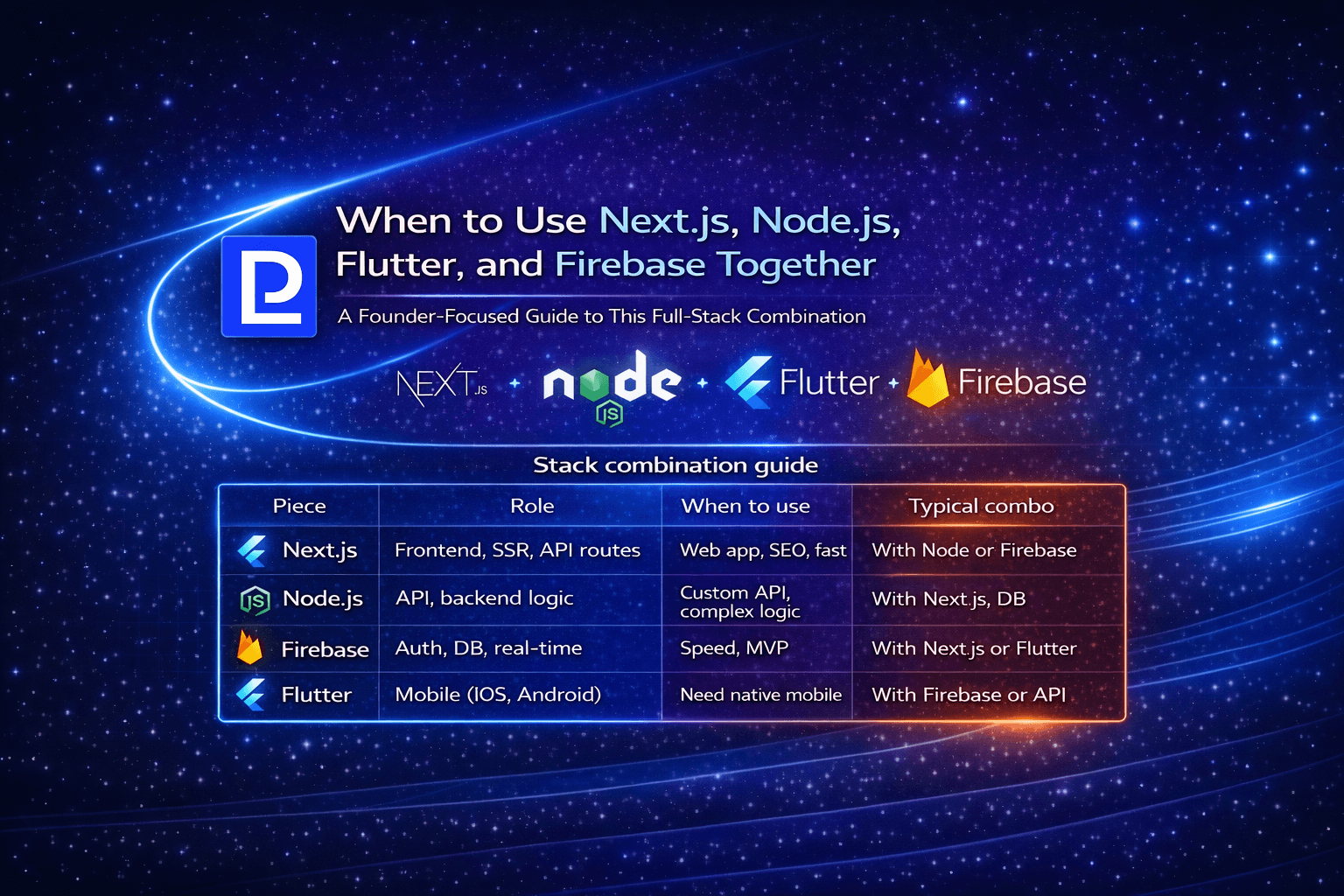
When to Use Next.js, Node.js, Flutter, and Firebase Together
A founder-focused guide to combining Next.js, Node.js, Flutter, and Firebase: when the stack makes sense and how to use them together.
Technology • 3 min
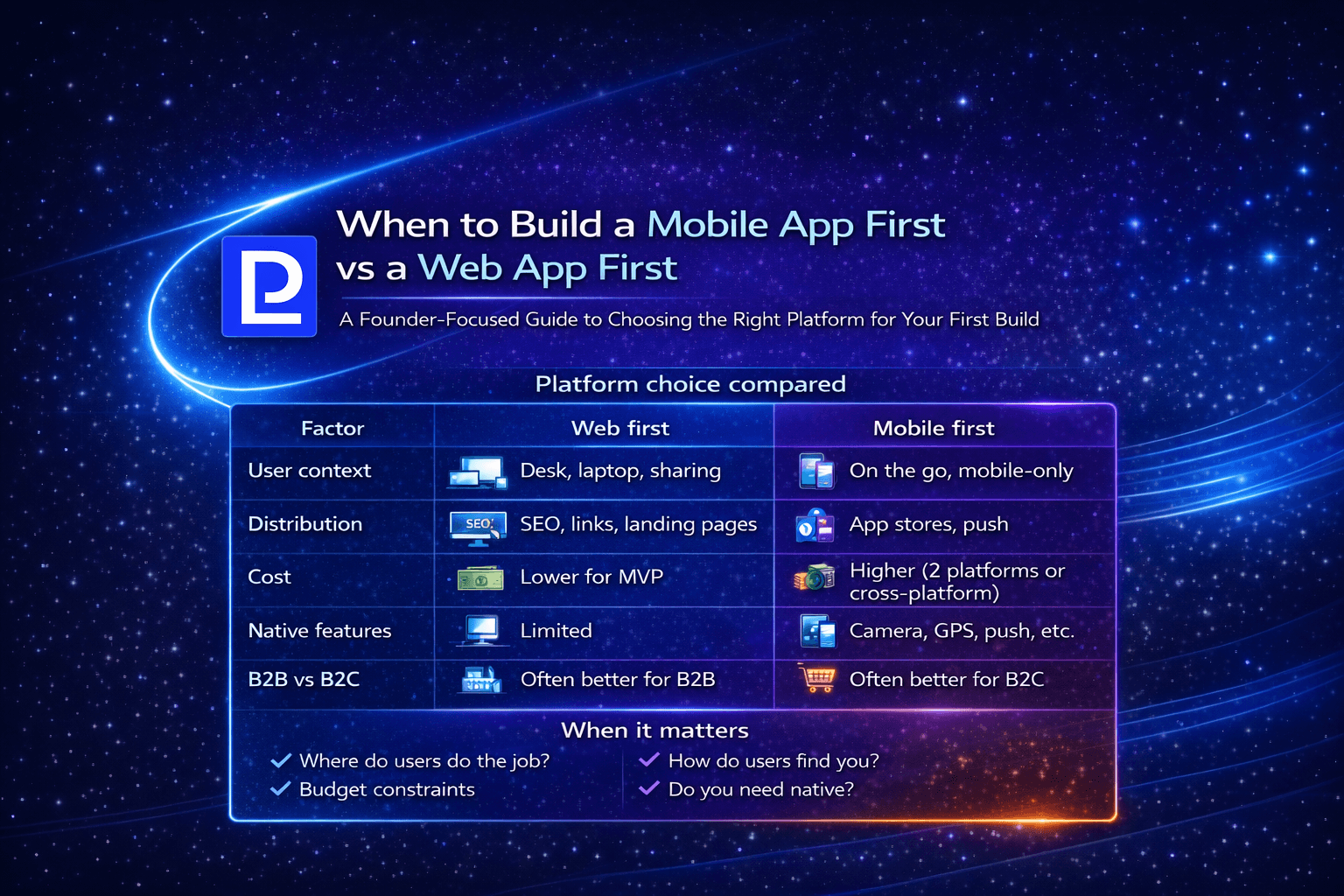
When to Build a Mobile App First vs a Web App First
A founder-focused guide to choosing mobile-first vs web-first: when each makes sense, tradeoffs, and how to decide for your product.