How to Build a Startup MVP
This guide explains how to build a startup MVP with disciplined scope, better prioritization, and enough technical depth to avoid a weak first release.
Key Takeaways
- 01
An MVP should answer one business question clearly.
- 02
The first release is stronger when it centers on one value loop and cuts secondary workflows.
- 03
Manual operations are often acceptable if they reduce early engineering waste.
- 04
Launch planning should include feedback and measurement, not just shipping.
- 05
Founders create leverage by making scope decisions quickly and explicitly.
How to Build a Startup MVP matters because buyers and founders need a clear answer, not a vague range or a stack of agency buzzwords. This guide explains how to build a startup MVP in a commercially realistic way so you can make better product, budget, and delivery decisions.
The short version: a strong MVP is not a smaller full product. It is a deliberately narrow release built to answer one commercial question with as little wasted engineering as possible.
Quick answer
how to build a startup MVP should be evaluated through scope, delivery risk, and business usefulness, not just a headline number or trend-driven opinion.
- Build the smallest workflow that can prove a business decision.
- Defer complexity that does not change learning or revenue.
- Launch plans should include feedback loops, not just build tasks.
Who this guide is for
This guide is for startup founders, product teams, and service businesses turning an idea into a first release that can test demand or operational value.
What to build first and what to delay
Good MVP planning starts with the main user journey and the smallest version of it that still creates a meaningful result. That often means one persona, one clear workflow, and basic operations hidden behind simple admin tooling rather than expensive automation.
What should wait? Multi-role complexity, advanced reporting, broad permissions, and workflows that only matter after adoption. Early-stage teams save money when they postpone complexity that has not earned its place yet.
| Build first | Build later | Reason |
|---|---|---|
| One core workflow | Secondary feature branches | Validation needs focus |
| Basic admin visibility | Heavy automation | Manual operations are acceptable early |
| Tracking and feedback | Deep settings systems | Learning beats polish in v1 |
Launching a startup product without validating the idea can lead to wasted time and development costs. Many successful startups begin with an MVP — a Minimum Viable Product — to test their concept with real users before investing in full product development.
An MVP focuses on solving the core problem for users while keeping the product simple. Instead of building a complex platform immediately, founders launch a smaller version that allows them to gather feedback and improve the product.
This guide explains how startups can build a successful MVP, what steps are involved, and how to avoid common development mistakes.
What Is a Startup MVP?
A Minimum Viable Product is the simplest version of a product that solves a core problem for users. It includes only the most essential features required to validate the idea.
The purpose of an MVP is not to build a perfect product. The goal is to test assumptions, understand user behavior, and confirm whether the product solves a real market problem.
Once the MVP is launched and validated, startups can gradually expand the product with new features.
Why Startups Should Build an MVP
Building an MVP helps startups reduce risk and avoid spending large amounts of money on untested ideas.
Some key benefits of MVP development include:
- Faster product launch
- Lower development costs
- Early user feedback
- Market validation
- Ability to pivot quickly
Instead of building a complete platform immediately, startups learn from real user behavior and improve the product based on feedback.
Step 1: Define the Core Problem
Every successful product solves a specific problem. Before starting development, founders must clearly define what problem their product addresses and who the target users are.
Understanding the problem helps determine which features are truly necessary for the MVP.
Step 2: Identify the Core Features
Many founders try to include too many features in their first product. This increases development time and delays the launch.
An MVP should include only the features required to deliver the core value of the product.
Examples of typical MVP features include:
- User registration and authentication
- Basic product functionality
- Simple dashboard or interface
- Data storage
- Basic analytics or tracking
Additional features can be added later after validating the product.
Step 3: Build a Product Prototype
Before writing code, many startups build prototypes to visualize the product. Prototypes help founders understand the user flow and product structure.
UI and UX designers often create wireframes that show how users will interact with the application.
This step allows teams to identify usability issues before development begins.
Step 4: Choose the Right Tech Stack
The technology stack determines how scalable and maintainable the product will be. Startups often choose modern frameworks that allow fast development and strong performance.
Common technologies for MVP development include:
- Next.js or React for frontend development
- Node.js or Python for backend development
- PostgreSQL or MongoDB for databases
- Cloud infrastructure such as AWS
Choosing the right stack ensures the MVP can evolve into a full product later.
Step 5: Start Development
Once planning is complete, development teams begin building the MVP. This stage focuses on implementing the core features and ensuring the product works reliably.
Many teams use agile development methodologies to release features incrementally and test them continuously.
Testing during development helps identify bugs early and improve product stability.
Step 6: Launch the MVP
The MVP should be released as soon as the core functionality works reliably. Launching early allows startups to gather real user feedback and measure product performance.
Early users often provide valuable insights that help refine the product.
This feedback guides future development decisions.
Step 7: Collect Feedback and Improve
After launching the MVP, startups should closely analyze how users interact with the product. Feedback can reveal usability problems, missing features, or unexpected user behavior.
Based on this data, the product can evolve into a more advanced platform.
This iterative approach helps build products that truly meet market needs.
Common MVP Development Mistakes
Startups sometimes struggle during MVP development because they misunderstand its purpose.
Common mistakes include:
- Building too many features
- Skipping user validation
- Ignoring scalability
- Choosing technologies based on trends instead of stability
A successful MVP focuses on simplicity and learning from real users.
How Long Does It Take to Build an MVP?
The timeline for MVP development depends on product complexity. Most startup MVPs can be built within two to four months.
Simple applications may launch faster, while more complex platforms require additional development time.
Conclusion
Building a startup MVP is one of the most effective strategies for launching a successful product. By focusing on core functionality, startups can validate ideas quickly, reduce development risk, and build products based on real user feedback.
A well-planned MVP creates the foundation for long-term product growth and scalability.
Choose a narrower MVP when...
If the team is still learning who the main user is, how adoption will happen, or which part of the workflow creates value, choose a narrower MVP. Only widen scope when the business signal demands it.
Common founder mistake
Many teams treat the MVP as a small version of the final roadmap and end up shipping a product that is too wide to build efficiently and too unfocused to teach anything clearly.
MVP checklist
- Name the one metric or business question the release must answer.
- Identify the minimum user journey needed to answer it.
- Cut every feature that does not materially support that journey.
- Plan feedback capture and analytics before launch.
- Keep room in the budget for post-launch iteration.
Useful companion reads: MVP development for startups, MVP cost breakdown, and our product development process.
What to do next
Write the single question your MVP must answer, cut the roadmap until it serves that question, and review real product slices early. That is how founders protect both budget and momentum. If you need help shaping the first release, see our product development process and contact our team.
Apply this in a real project
If you’re planning to build or improve software based on these ideas, our custom software development services can help you define scope, reduce delivery risk, and ship maintainable systems.
For founder-led execution, explore our product development services and web development services to turn requirements into a working release with clear ownership.
Expert Insights
Version one should prove something important
An MVP is worth shipping only when it answers a real question about adoption, willingness to pay, or workflow value.
Manual operations are underrated
Founders often automate too soon. Manual handling in the first version can be a smart way to learn before engineering a brittle process.
Frequently Asked Questions
What should an MVP include?+
What should not be built first?+
How long should MVP development take?+
How do founders know the MVP is too small?+
What happens after the MVP launches?+
Reader Questions
How do I avoid underbuilding the MVP?
Make sure the core user can complete the core job. Underbuilding is a problem only when the product cannot create a meaningful signal.
Should I include payments in the first release?
Include them if willingness to pay is part of the question you need answered. Otherwise, you may be able to defer billing briefly.
What is the founder role during MVP delivery?
Founders are most valuable when they clarify priorities quickly, review live product slices, and keep the build tied to the real business goal.
Related Articles
Technology • 3 min
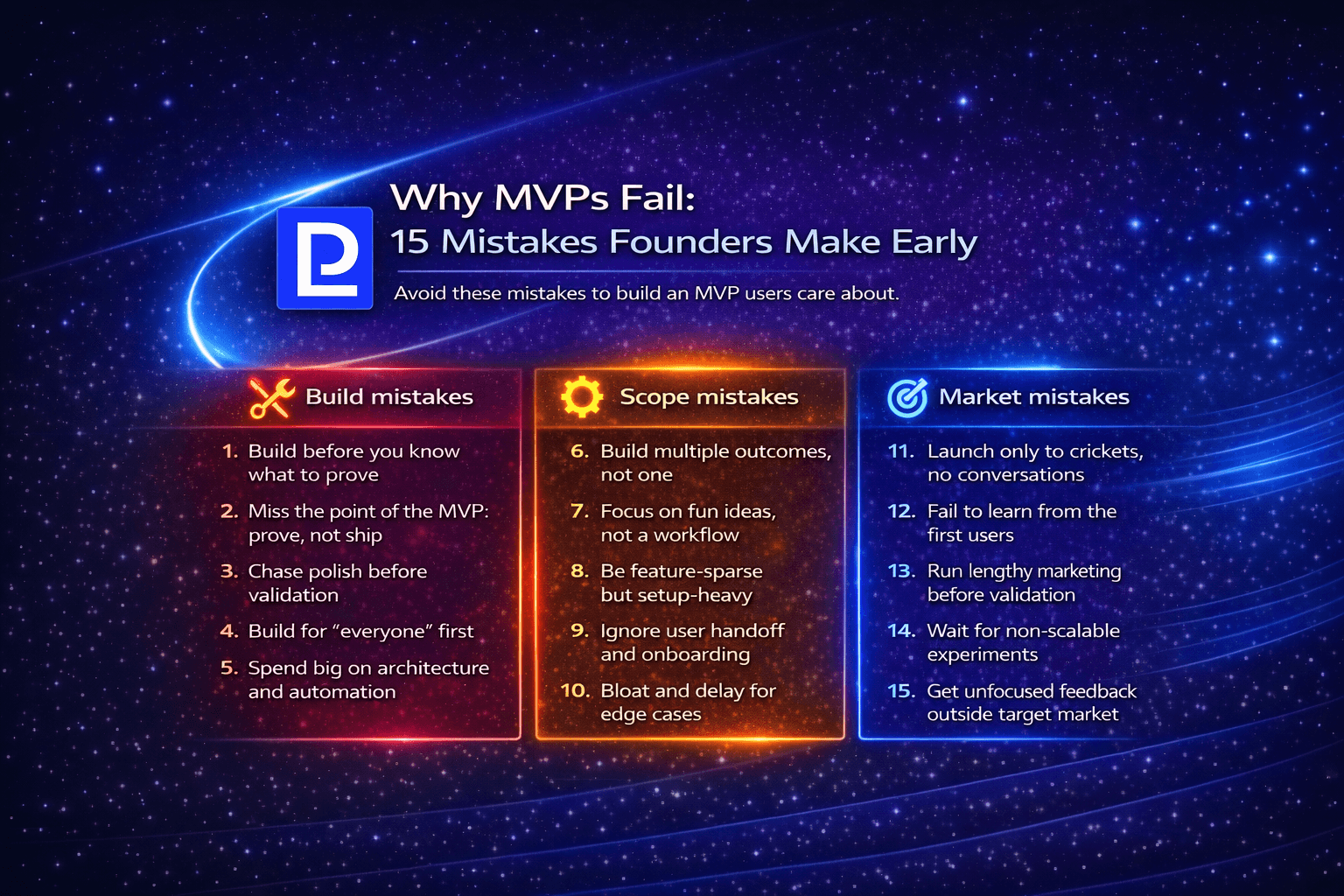
Why MVPs Fail: 15 Mistakes Founders Make Early
A founder-focused guide to the 15 most common MVP mistakes: what causes failure, how to avoid them, and how to build MVPs that actually validate.
Technology • 3 min
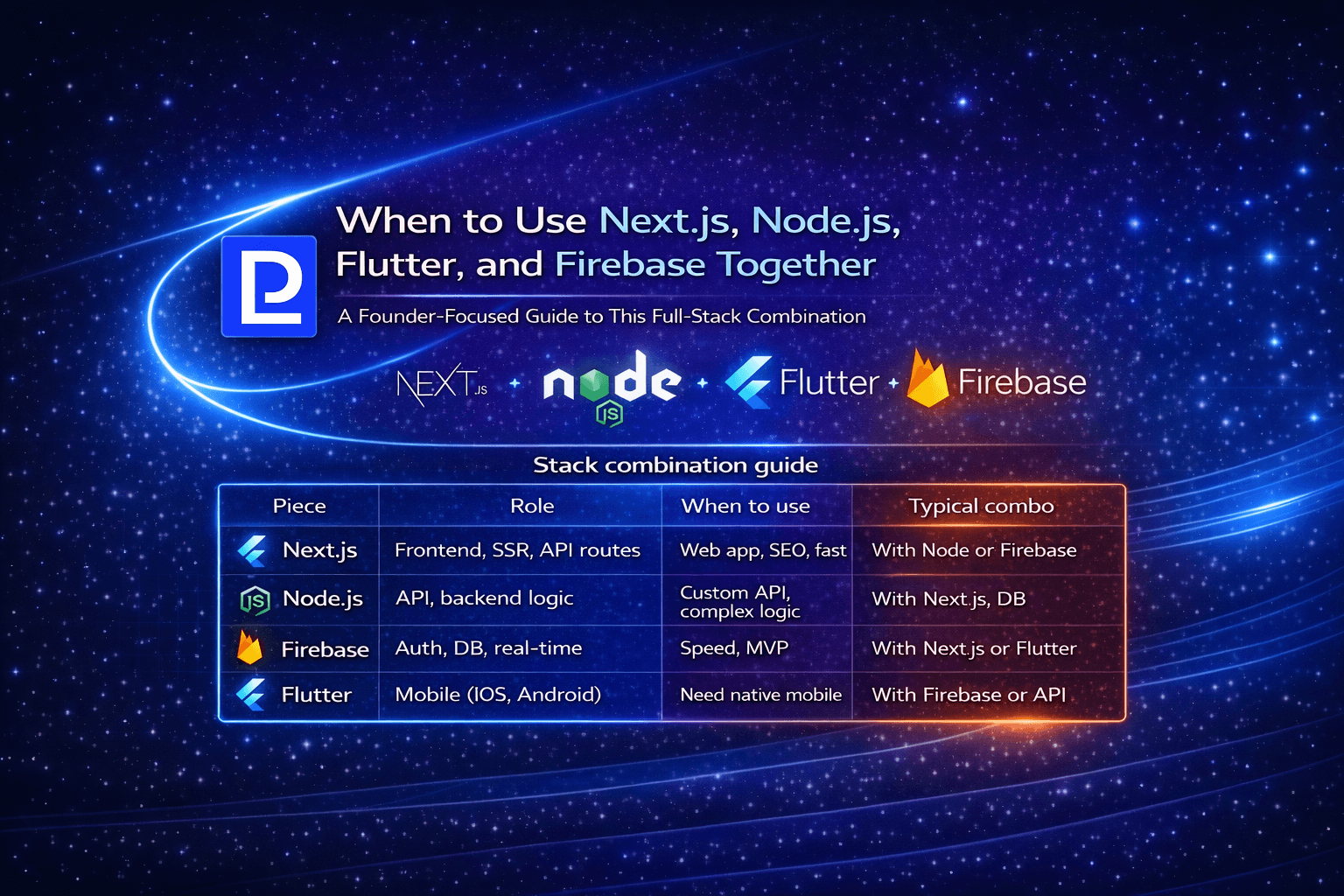
When to Use Next.js, Node.js, Flutter, and Firebase Together
A founder-focused guide to combining Next.js, Node.js, Flutter, and Firebase: when the stack makes sense and how to use them together.
Technology • 3 min
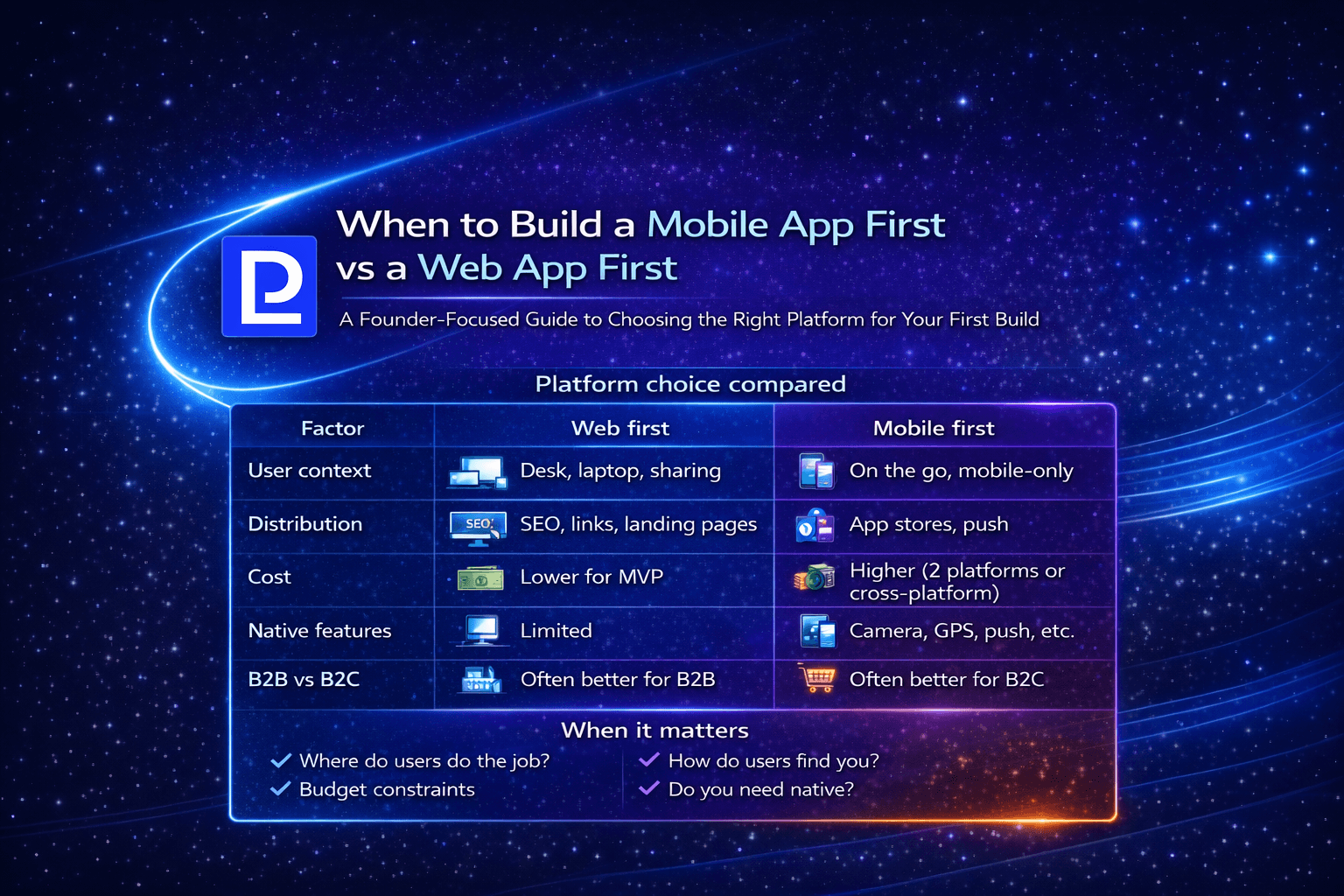
When to Build a Mobile App First vs a Web App First
A founder-focused guide to choosing mobile-first vs web-first: when each makes sense, tradeoffs, and how to decide for your product.