How Founders Choose a Software Development Partner (Without Risking Their Product)
A founder-focused guide to choosing a software development partner with less delivery risk, better communication, and clearer technical ownership.

Key Takeaways
- 01
Ownership and communication quality usually matter more than the cheapest rate.
- 02
Strong partners reduce risk by making scope, QA, and milestones visible.
- 03
A team that challenges vague requirements is often safer than a team that agrees too quickly.
- 04
Documentation, repo access, and handover terms should be clear before work starts.
- 05
The best partner fit depends on how much internal product leadership you already have.
How Founders Choose a Software Development Partner (Without Risking Their Product) matters because buyers and founders need a clear answer, not a vague range or a stack of agency buzzwords. This guide explains software development partner in a commercially realistic way so you can make better product, budget, and delivery decisions.
The short version: the best partner is not the one that says yes to every feature request. It is the one that can explain scope, challenge risky assumptions, and show how delivery will stay visible from week one.
Quick answer
software development partner should be evaluated through scope, delivery risk, and business usefulness, not just a headline number or trend-driven opinion.
- Evaluate ownership, communication rhythm, QA, and handover clarity before price alone.
- Healthy teams explain tradeoffs and delivery risk in plain language.
- You should see how decisions are tracked and how progress becomes visible.
Who this guide is for
This guide is for founders and non-technical buyers who need outside delivery help but do not want to lose control of quality, timelines, or technical ownership.
How to reduce delivery risk early
Founders should treat partner selection as a risk-control decision. Ask how the team handles ambiguity, reviews working software, documents decisions, and escalates blockers. Those answers matter more than polished sales decks.
A reliable team will usually narrow scope before expanding it. That is not a lack of ambition. It is how experienced teams protect momentum.
| What to evaluate | Healthy signal | Red flag |
|---|---|---|
| Ownership | Named lead and clear accountability | Everyone codes, nobody owns delivery |
| Process | Milestones, demos, written updates | Loose promises and vague progress |
| Quality | QA, review, documentation | Speed-only pitch |
| Partnership style | Challenges bad scope politely | Says yes to everything |
Choosing a software development partner is one of the most critical decisions a founder makes. The right partner helps you move faster, reduce technical risk, and scale your product with confidence. The wrong one can delay launches, increase costs, and create long-term maintenance problems.
Many founders don’t fail because of bad ideas — they fail because they choose the wrong development team.
This guide explains how experienced founders evaluate software development partners, what signals actually matter, and how to avoid common outsourcing mistakes.
Why Founders Work With External Development Teams
Early-stage and growing companies rarely build everything in-house. A strong software development company allows founders to:
- Launch faster without building a full engineering department
- Access specialized expertise (architecture, performance, mobile, integrations)
- Reduce hiring risk and overhead
- Focus on business growth while delivery is handled professionally
The goal isn’t “outsourcing.”
The goal is building a reliable technical partnership.
1. Founders Look for Ownership — Not Just Coding
The biggest difference between a freelancer and a true software development partner is ownership.
Good founders ask:
- Who is responsible for delivery?
- Who manages technical decisions?
- Who ensures quality and long-term maintainability?
A strong development company should provide:
- Clear technical leadership
- Defined delivery milestones
- Documentation and handover processes
- Transparent communication
If the team only talks about features or hours, that’s a red flag.
2. Communication and Process Matter More Than Stack
Many founders initially focus on technologies — React, Flutter, Next.js, Node.js — but experienced teams know that process matters more.
Look for a partner that explains:
- Weekly delivery cycles or sprint planning
- Progress updates and reporting
- Risk management and escalation paths
- Testing and release workflows
A structured delivery process reduces uncertainty and keeps projects predictable.
3. Evaluate How They Approach Risk
Serious founders think about risk before writing a single line of code.
Ask potential partners:
- How do you prevent scope creep?
- What happens if requirements change?
- How do you ensure code quality over time?
Professional software development services should include:
- Architecture planning
- QA checkpoints
- Performance reviews
- Long-term scalability planning
If a team promises speed without governance, it often leads to technical debt later.
4. Real Partners Think About Product Outcomes — Not Just Features
Founders don’t need developers who simply execute tasks. They need partners who understand product thinking.
A strong development partner will ask questions like:
- Who is the end user?
- What problem are we solving?
- How does this feature affect scalability or growth?
This mindset turns development into a strategic asset rather than just execution work.
5. Transparency Builds Long-Term Trust
Founders should feel comfortable asking about:
- Team structure
- Delivery timelines
- Technical decisions
- Pricing and engagement models
Clear communication early in the relationship reduces misunderstandings later.
Many successful founder-partner relationships start with a consultation phase where goals, risks, and expectations are aligned before development begins.
6. How to Compare Software Development Companies
When evaluating multiple partners, focus on these factors:
Technical Capability
- Experience building scalable web or mobile applications
- Knowledge of modern frameworks and architecture patterns
Delivery Model
- Structured milestones
- Clear ownership
- Ongoing support after launch
Communication Style
- Founder-friendly explanations
- Consistent updates
- Honest timelines
Long-Term Support
- Maintenance options
- Performance optimization
- Future feature planning
A good partner is not just a vendor — they become part of your product journey.
7. Common Mistakes Founders Should Avoid
Many founders make similar mistakes when selecting a development partner:
- Choosing purely based on cost instead of reliability
- Ignoring communication processes
- Skipping technical planning before development begins
- Treating development as a short-term task rather than a long-term relationship
Avoiding these mistakes dramatically improves project success.
Conclusion
A software development partner should help founders move faster without increasing risk. The best partnerships combine technical expertise, structured delivery, and strong communication.
If you’re building a product or planning your next development phase, take time to evaluate partners based on ownership, process, and long-term support — not just tools or pricing.
Choosing the right development partner isn’t just a technical decision.
It’s a strategic one that shapes how your product evolves.
Decision checklist: choosing a partner without increasing risk
Use this checklist before you sign. It’s designed to surface delivery risk early.
- Ownership: Who owns architecture decisions, QA, releases, and documentation?
- Governance: Do you get milestones, written updates, and clear escalation paths?
- Access: Do you get repo access, issue tracker visibility, and predictable demos?
- Quality: What is the testing approach and definition of done?
- Handover: What documentation is included and how is knowledge transferred?
If you want a partner with structured delivery, explore our product development services, custom software development services, or software consulting services.
Choose this type of partner if...
Choose a full delivery partner when you need product thinking, technical leadership, QA, and predictable milestones. Choose dedicated developers only when you already have strong internal product leadership and a steady backlog.
Common hiring mistake
The most expensive mistake is choosing a team because they are agreeable and affordable while never verifying how they manage scope, quality, and accountability. Founders pay for that later in delays and technical debt.
Partner evaluation checklist
- Ask who owns architecture, QA, delivery, and releases.
- Review how often you will see working software.
- Confirm repo access, documentation, and handover terms.
- Look for thoughtful pushback on risky scope.
- Compare communication quality, not just hourly rates.
If you are comparing delivery options, also read build vs buy vs partner, how dedicated developers differ from a full partner, and our software consulting support.
What to do next
Shortlist partners based on ownership, communication, and quality controls before you compare numbers. A slightly more expensive team with clear governance is usually cheaper than a vague team that needs rescuing later. If you want a structured starting point, explore our custom software development services, software consulting support, or contact our team.
Apply this in a real project
If you’re planning to build or improve software based on these ideas, our custom software development services can help you define scope, reduce delivery risk, and ship maintainable systems.
For founder-led execution, explore our product development services and software consulting services to turn requirements into a working release with clear ownership.
Expert Insights
A reliable process is a commercial asset
Structured demos, written updates, and clear ownership are not administrative overhead. They are how buyers stay aligned and reduce expensive surprises.
The right pushback is a positive signal
A strong partner protects the product by challenging fuzzy requirements, unclear success criteria, and risky timing assumptions.
Tags
Frequently Asked Questions
What should founders ask a development partner first?+
Is a cheaper team always riskier?+
What signals a strong delivery process?+
Should founders choose specialists or a full-service partner?+
What should happen after launch?+
Reader Questions
How involved do I need to be as a founder?
You do not need to micromanage delivery, but you do need to stay close to scope priorities, decisions, and business context.
What if I do not understand the technical details?
A good partner should still be able to explain risks, tradeoffs, and options in business terms you can act on.
Can I start small before committing fully?
Yes. Many teams start with a discovery or scoped first milestone before expanding into a larger engagement.
Need a delivery partner with clear ownership?
We help founders plan, build, and ship software with predictable milestones, transparent communication, and maintainable engineering.
Continue the conversationRelated Articles
Technology • 3 min
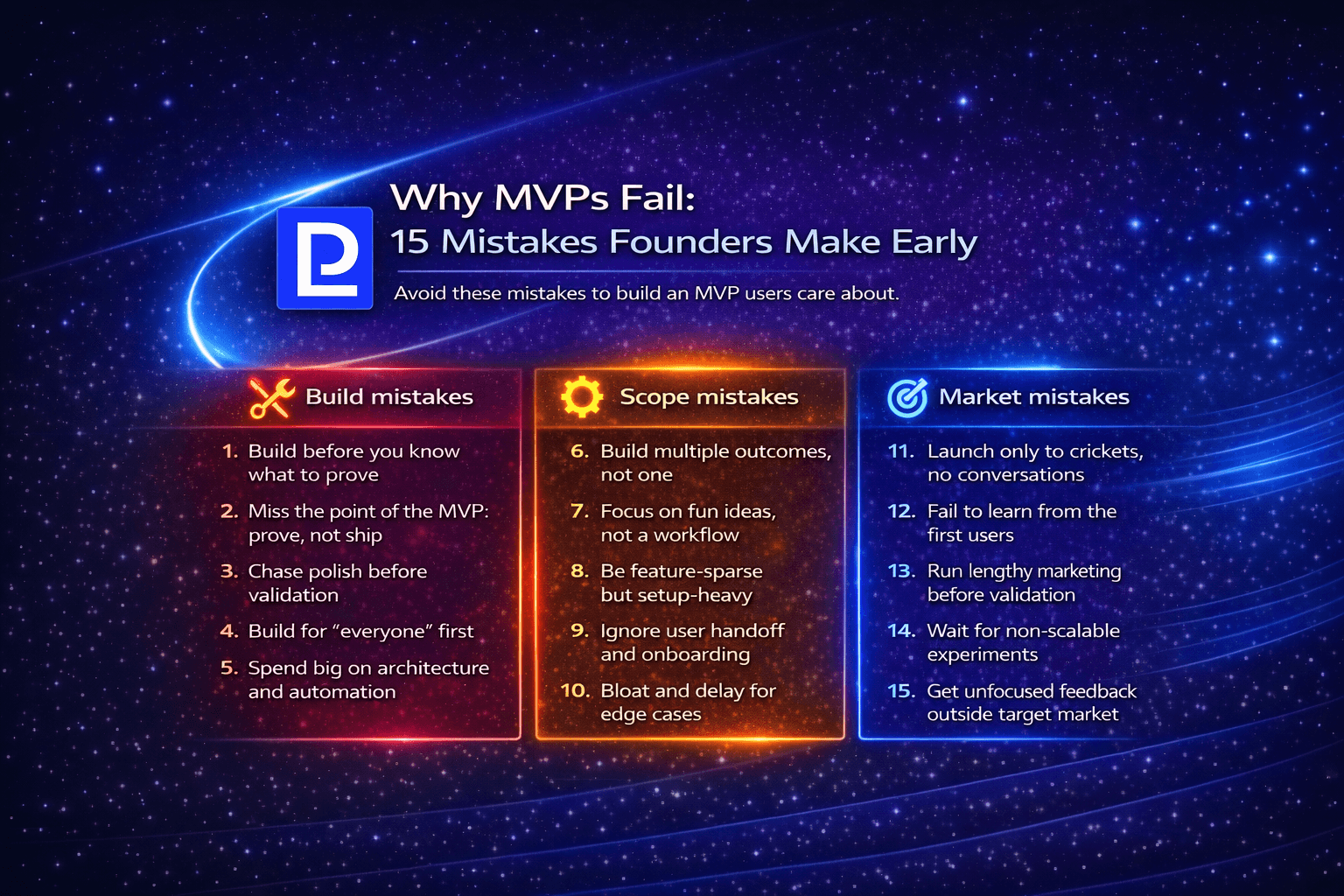
Why MVPs Fail: 15 Mistakes Founders Make Early
A founder-focused guide to the 15 most common MVP mistakes: what causes failure, how to avoid them, and how to build MVPs that actually validate.
Technology • 3 min
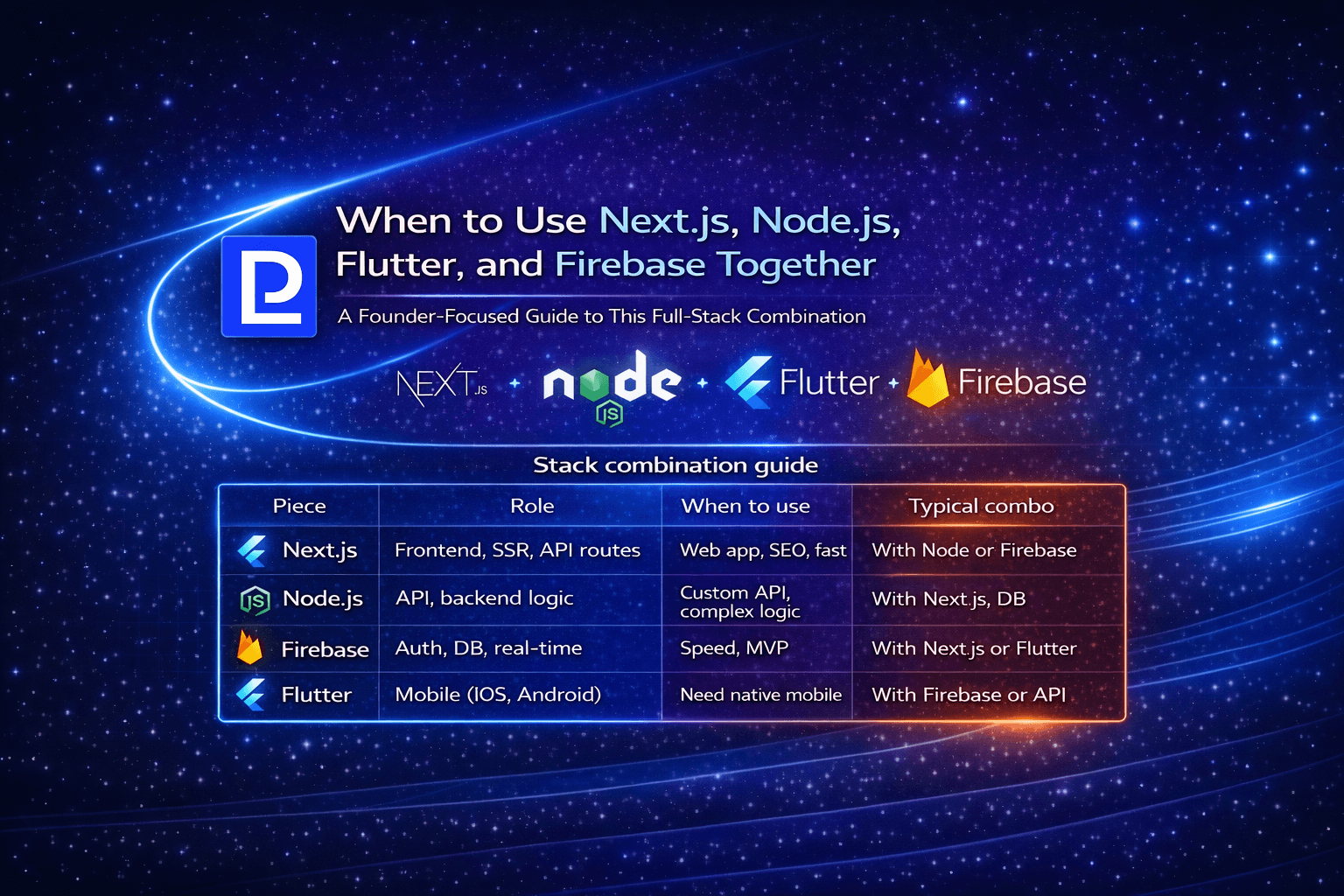
When to Use Next.js, Node.js, Flutter, and Firebase Together
A founder-focused guide to combining Next.js, Node.js, Flutter, and Firebase: when the stack makes sense and how to use them together.
Technology • 3 min
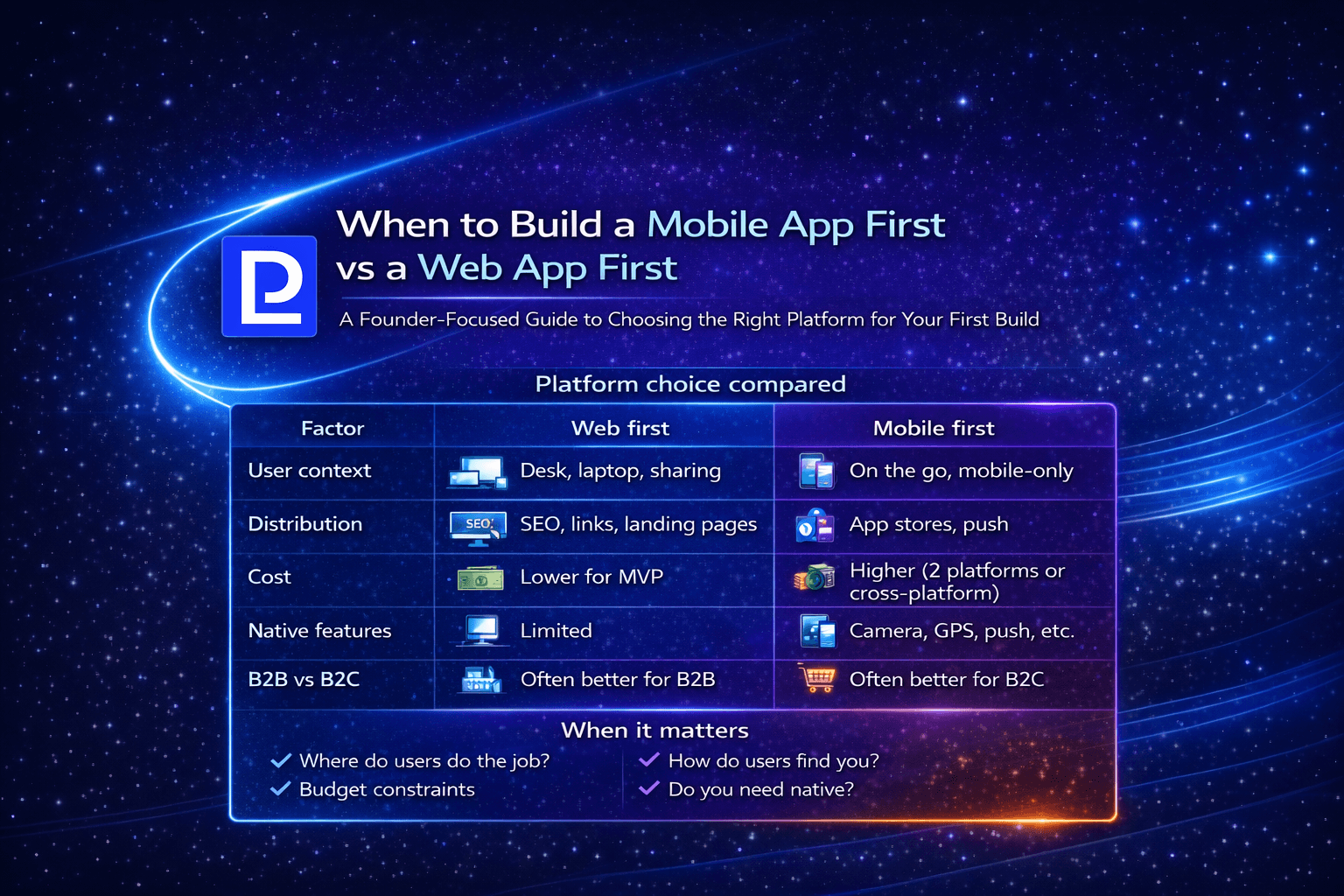
When to Build a Mobile App First vs a Web App First
A founder-focused guide to choosing mobile-first vs web-first: when each makes sense, tradeoffs, and how to decide for your product.