Custom Software Development Services: A Complete Guide for Businesses
A buyer-focused guide to custom software development services, including what is actually included, how delivery works, and how to compare providers well.
Key Takeaways
- 01
Custom software services should include scope thinking, engineering discipline, and support planning.
- 02
Buyers should compare what each proposal actually includes, not just the headline price.
- 03
Discovery and QA are not optional extras when delivery quality matters.
- 04
The strongest providers connect product decisions to technical execution.
- 05
A clear process is one of the biggest predictors of a healthy engagement.
Custom Software Development Services: A Complete Guide for Businesses matters because buyers and founders need a clear answer, not a vague range or a stack of agency buzzwords. This guide explains custom software development services in a commercially realistic way so you can make better product, budget, and delivery decisions.
The short version: good software services are not just coding hours. They combine discovery, product thinking, design, engineering discipline, release process, and post-launch support.
Quick answer
custom software development services should be evaluated through scope, delivery risk, and business usefulness, not just a headline number or trend-driven opinion.
- Strong engagements define goals, scope boundaries, milestones, and quality expectations early.
- Good service partners reduce ambiguity instead of billing around it.
- The best outcomes come when product and engineering decisions stay connected.
Who this guide is for
This guide is for companies evaluating external product and engineering support, especially when off-the-shelf tools no longer fit the workflow.
What good software delivery service includes
At a practical level, good software service means someone is thinking through product logic, edge cases, QA, deployment, and what happens after launch. It is not just a line item for frontend and backend hours.
Buyers get better results when the engagement structure supports decision-making, not just task execution. That is where discovery, design review, and regular demos become commercially important.
| Service area | What good looks like |
|---|---|
| Discovery | Clear workflows, priorities, assumptions, and scope boundaries |
| Design | Usable flows that support the product goal, not just pretty screens |
| Engineering | Maintainable code, reviews, QA, and documented decisions |
| Support | Structured launch, monitoring, fixes, and iteration planning |
Custom software development services help businesses build digital products, internal tools, and scalable platforms designed around their exact goals. Unlike generic software, custom solutions are built to match your workflows, user needs, and long-term business strategy.
For startups, growing companies, and established businesses, custom software development can become a major competitive advantage. It allows teams to automate operations, improve customer experience, and create technology that supports growth instead of limiting it.
This guide explains what custom software development services include, when businesses should invest in them, and how to choose the right development partner.
What Are Custom Software Development Services?
Custom software development services involve designing, building, testing, and maintaining software tailored to a business’s unique requirements. These services go beyond coding. They usually include product planning, system architecture, UI/UX design, backend development, integrations, quality assurance, deployment, and long-term support.
Businesses use these services to create:
- Web applications
- Mobile applications
- Internal dashboards and admin panels
- Automation systems
- Customer portals
- Custom SaaS products
- Industry-specific software tools
The goal is not just to build software, but to create a solution that fits the business model and scales over time.
Why Businesses Choose Custom Software Development Services
Many businesses start with off-the-shelf tools, but those tools often become restrictive as operations grow. Standard software may force teams to change workflows, adopt unnecessary features, or work around limitations.
Custom software development services solve this by giving businesses full flexibility. Companies choose custom software when they want to:
- Build unique product experiences
- Automate manual processes
- Connect multiple systems and integrations
- Improve security and performance
- Support future scalability
- Maintain full ownership of technology
Instead of fitting the business into a generic tool, custom development allows the software to fit the business.
What Is Included in Custom Software Development Services?
1. Product Discovery and Planning
Every successful software project begins with understanding the business problem. Discovery includes defining goals, mapping workflows, prioritizing features, understanding users, and setting a realistic roadmap.
This phase reduces ambiguity and helps businesses avoid unnecessary development costs.
2. UI/UX Design
Custom software should not only work well but also feel intuitive. UI/UX design services usually include wireframes, user flows, prototypes, and interface design.
Good design improves usability, adoption, and product retention.
3. Frontend and Backend Development
This is the core engineering phase. Frontend development focuses on user-facing interfaces, while backend development handles business logic, databases, APIs, and system architecture.
Together, these layers create the complete software experience.
4. Integrations
Modern software rarely works in isolation. Custom software development services often include integrations with payment gateways, CRMs, ERPs, analytics tools, messaging systems, and third-party APIs.
These integrations help businesses centralize operations and improve efficiency.
5. Quality Assurance and Testing
Reliable software requires structured testing. QA ensures the product performs correctly across different scenarios and devices. This includes functional testing, responsiveness testing, bug checks, and performance validation.
Testing reduces risk before launch.
6. Deployment and Ongoing Support
After development, software must be deployed correctly and monitored over time. Support services often include maintenance, feature updates, performance optimization, bug fixing, and infrastructure scaling.
This long-term support is essential for growing businesses.
When Should a Business Invest in Custom Software Development Services?
Not every business needs custom software immediately. However, there are clear signs when investing in custom development becomes worthwhile.
A business should consider custom software development services when:
- Off-the-shelf tools no longer fit business workflows
- Manual processes consume too much time
- Teams rely on multiple disconnected systems
- The company needs a unique digital product
- Scalability and performance are becoming a concern
- Customer experience depends on custom features
In these cases, custom development often creates more value than layering more SaaS tools on top of old processes.
How Much Do Custom Software Development Services Cost?
The cost of custom software development services depends on scope, complexity, design requirements, integrations, timeline, and team structure.
Typical ranges include:
- Simple MVP: $15,000 – $60,000
- Mid-size business platform: $60,000 – $150,000
- Large-scale or enterprise system: $150,000+
These numbers vary widely depending on the product goals, but the key factor is not just cost — it is how effectively the software supports business growth.
Benefits of Working With a Custom Software Development Company
Choosing the right development partner gives businesses access to technical expertise, product thinking, and structured delivery processes.
A strong development company can help with:
- Architecture planning
- Scalable engineering decisions
- Faster product launches
- Reduced technical debt
- Long-term maintainability
- Better alignment between product and business goals
Instead of simply building features, the right partner helps businesses make smarter technical decisions.
How to Choose the Right Custom Software Development Partner
Not all teams approach custom software with the same level of ownership or strategic thinking. Businesses should evaluate development partners based on more than pricing.
Look for a team that offers:
- Clear communication and delivery process
- Experience building scalable applications
- Strong UI/UX and technical planning
- Transparent milestones and reporting
- Testing and quality assurance practices
- Ongoing support after launch
A great software development partner should help reduce risk, improve speed, and support long-term product success.
Common Mistakes Businesses Make
When investing in custom software development services, businesses often make avoidable mistakes such as:
- Choosing purely based on low cost
- Skipping discovery and planning
- Trying to build too many features at once
- Ignoring long-term maintenance needs
- Not defining business goals clearly
Avoiding these mistakes improves both budget efficiency and product quality.
Conclusion
Custom software development services give businesses the flexibility to build technology that matches their exact needs. Whether the goal is launching a digital product, automating internal workflows, or replacing disconnected tools, custom software can create long-term business value.
The right development approach combines clear planning, strong engineering, thoughtful design, and reliable support. Businesses that invest strategically in custom software often gain stronger systems, better customer experiences, and more room to grow.
When custom development services make sense
Custom development is usually justified when the workflow is a competitive advantage, off-the-shelf tools no longer fit, or several systems must work together around your business process.
Common buyer mistake
Many buyers compare vendors as if service means the same thing everywhere. In reality, one proposal may include discovery, QA, and launch support while another mostly covers implementation hours.
Buyer checklist
- Confirm what discovery outputs are included.
- Check how design, engineering, and QA are coordinated.
- Review milestone structure and reporting rhythm.
- Clarify support after launch.
- Ask how changes to scope are handled.
For more planning support, see our custom software development services, software consulting support, and contact our team.
What to do next
Compare service providers by how they define the work, show progress, and protect maintainability after launch. Good software delivery is visible, structured, and commercially grounded. To discuss your own build, visit our custom software development services or contact our team.
Apply this in a real project
If you’re planning to build or improve software based on these ideas, our custom software development services can help you define scope, reduce delivery risk, and ship maintainable systems.
For founder-led execution, explore our product development services and software consulting services to turn requirements into a working release with clear ownership.
Expert Insights
Delivery quality is visible in the process
The presence of discovery outputs, milestone discipline, QA, and post-launch thinking usually tells you more about service quality than portfolio screenshots alone.
Software services should reduce ambiguity
A good provider clarifies priorities, boundaries, and tradeoffs early instead of profiting from uncertainty later.
Tags
Frequently Asked Questions
What is included in custom software development services?+
How should buyers compare service providers?+
When should a business choose custom software?+
What makes an engagement go wrong?+
How long do custom projects usually take?+
Reader Questions
Should I expect strategy help from a service provider?
A strong provider should contribute to scope clarity and delivery tradeoffs, even if you own the business strategy.
What does a healthy kickoff look like?
A healthy kickoff aligns goals, scope, assumptions, communication rhythm, and what success looks like for the first milestone.
How do I avoid becoming dependent on one vendor?
Insist on documentation, repo access, predictable handover, and visibility into architecture and delivery decisions from the start.
Related Articles
Technology • 3 min
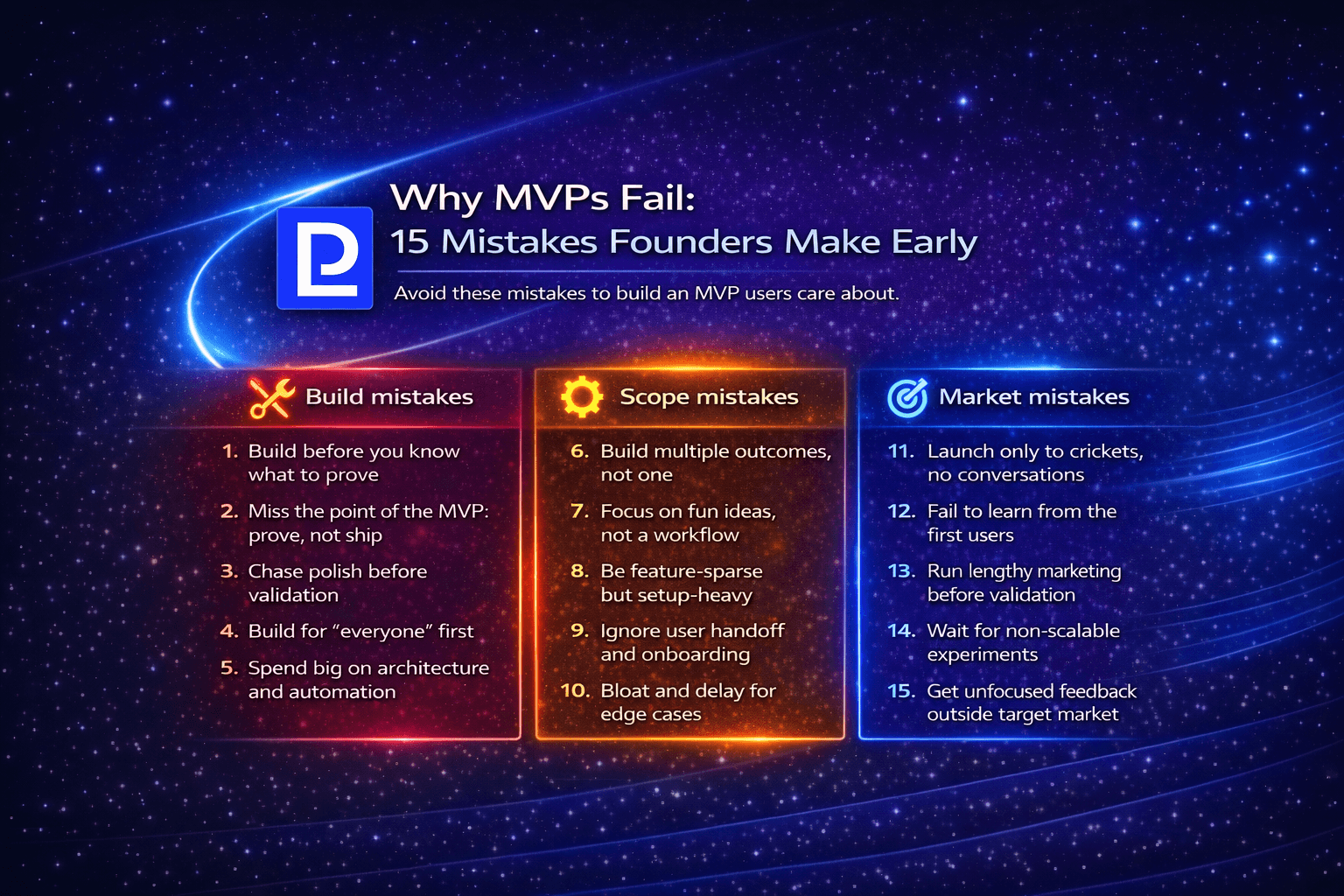
Why MVPs Fail: 15 Mistakes Founders Make Early
A founder-focused guide to the 15 most common MVP mistakes: what causes failure, how to avoid them, and how to build MVPs that actually validate.
Technology • 3 min
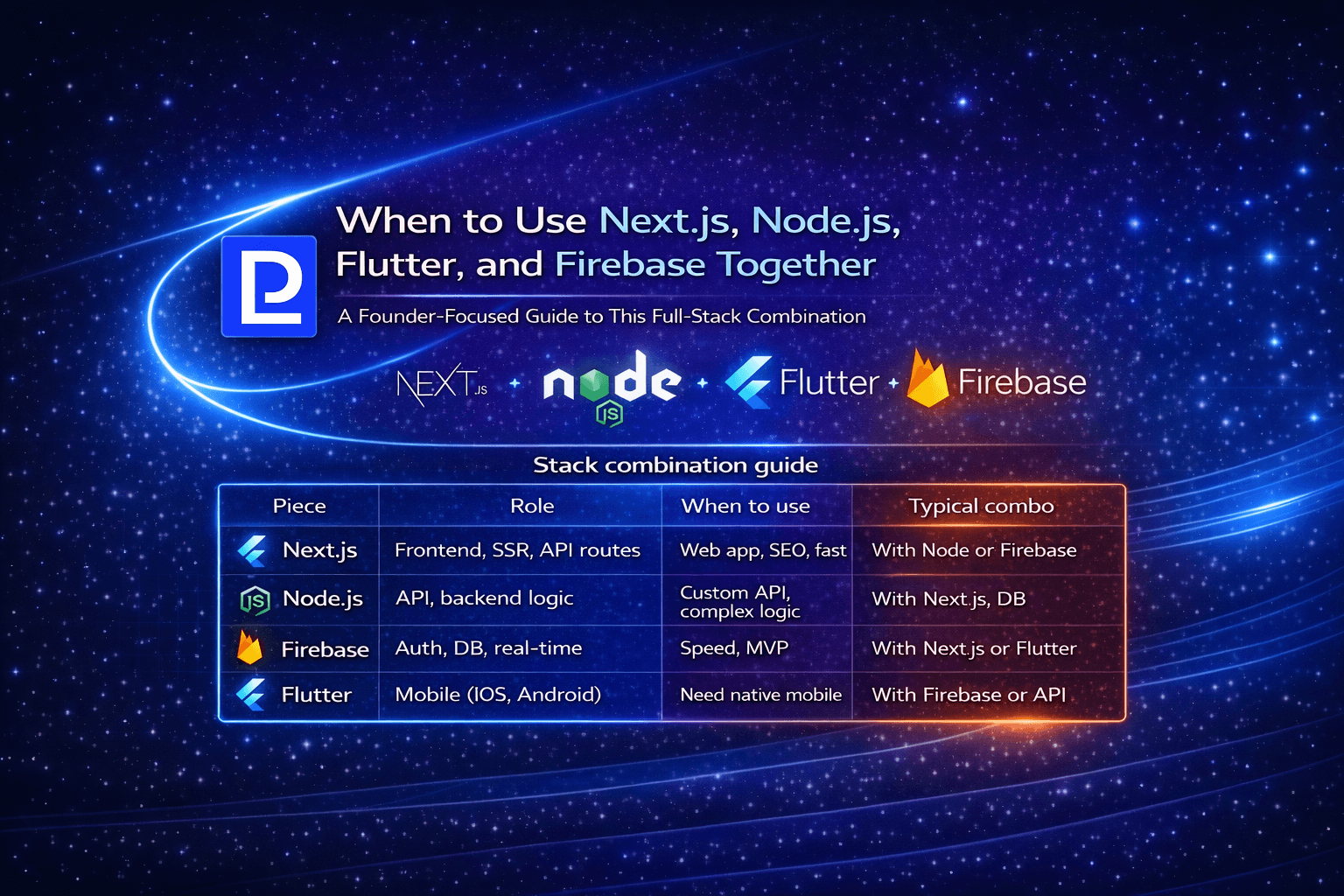
When to Use Next.js, Node.js, Flutter, and Firebase Together
A founder-focused guide to combining Next.js, Node.js, Flutter, and Firebase: when the stack makes sense and how to use them together.
Technology • 3 min
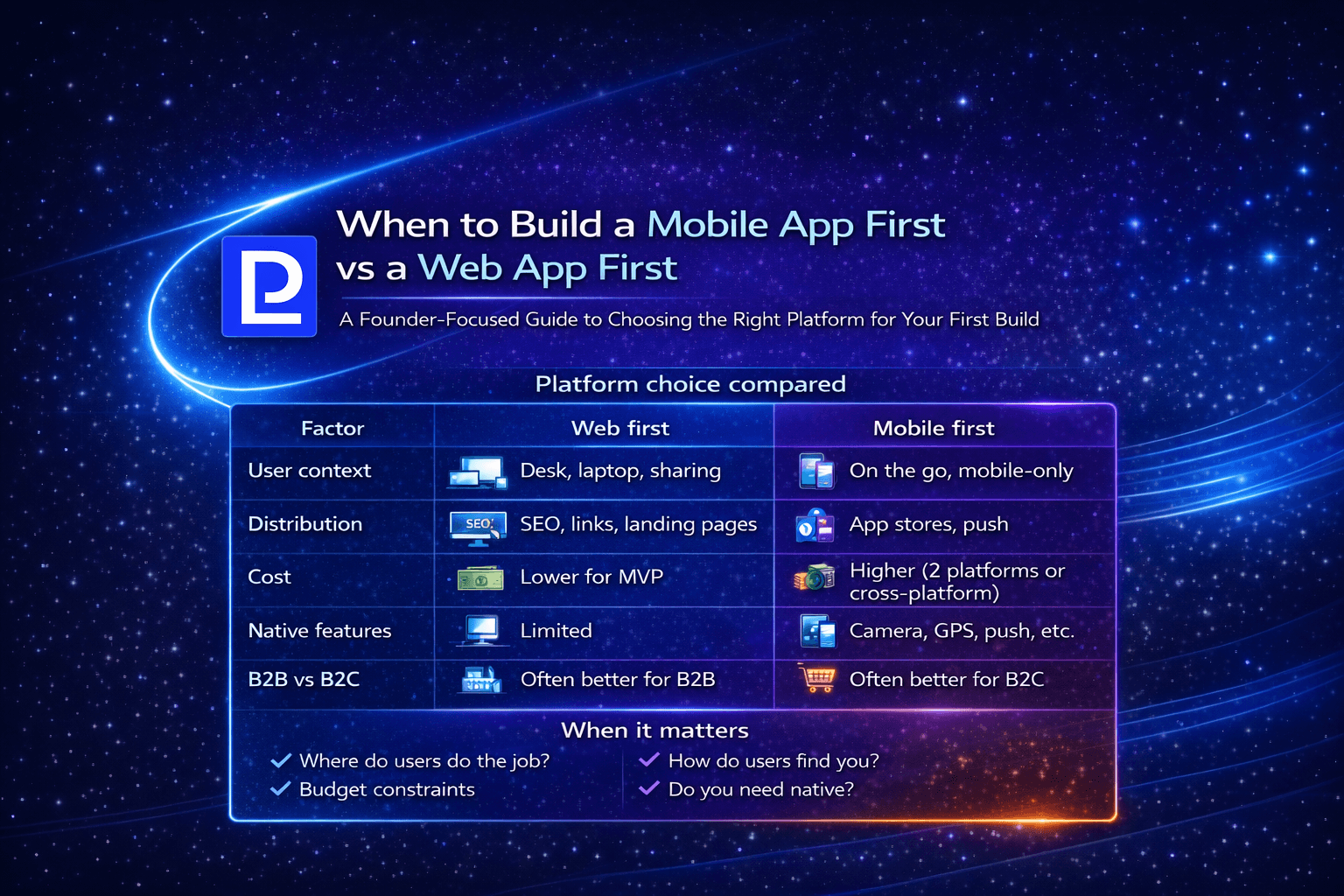
When to Build a Mobile App First vs a Web App First
A founder-focused guide to choosing mobile-first vs web-first: when each makes sense, tradeoffs, and how to decide for your product.